We make the VOLEC Pulse, so you should know that before you read another word. We’ll still try to be fair. The Ohme Home Pro is a very good charger, and for some homes it’s the better pick. The Pulse is a better fit for others. This post sets out what each one does so you can decide for yourself.
Both are 7kW class smart chargers for a normal single phase home. Both use a Type 2 connector, which fits every current electric car sold in the UK. Both are meant to charge your car when electricity is cheap and keep it from overloading your house. The differences are in how they do it, what extra hardware they need, and how you buy and install them.
“What are the VOLEC Pulse and the Ohme Home Pro?”
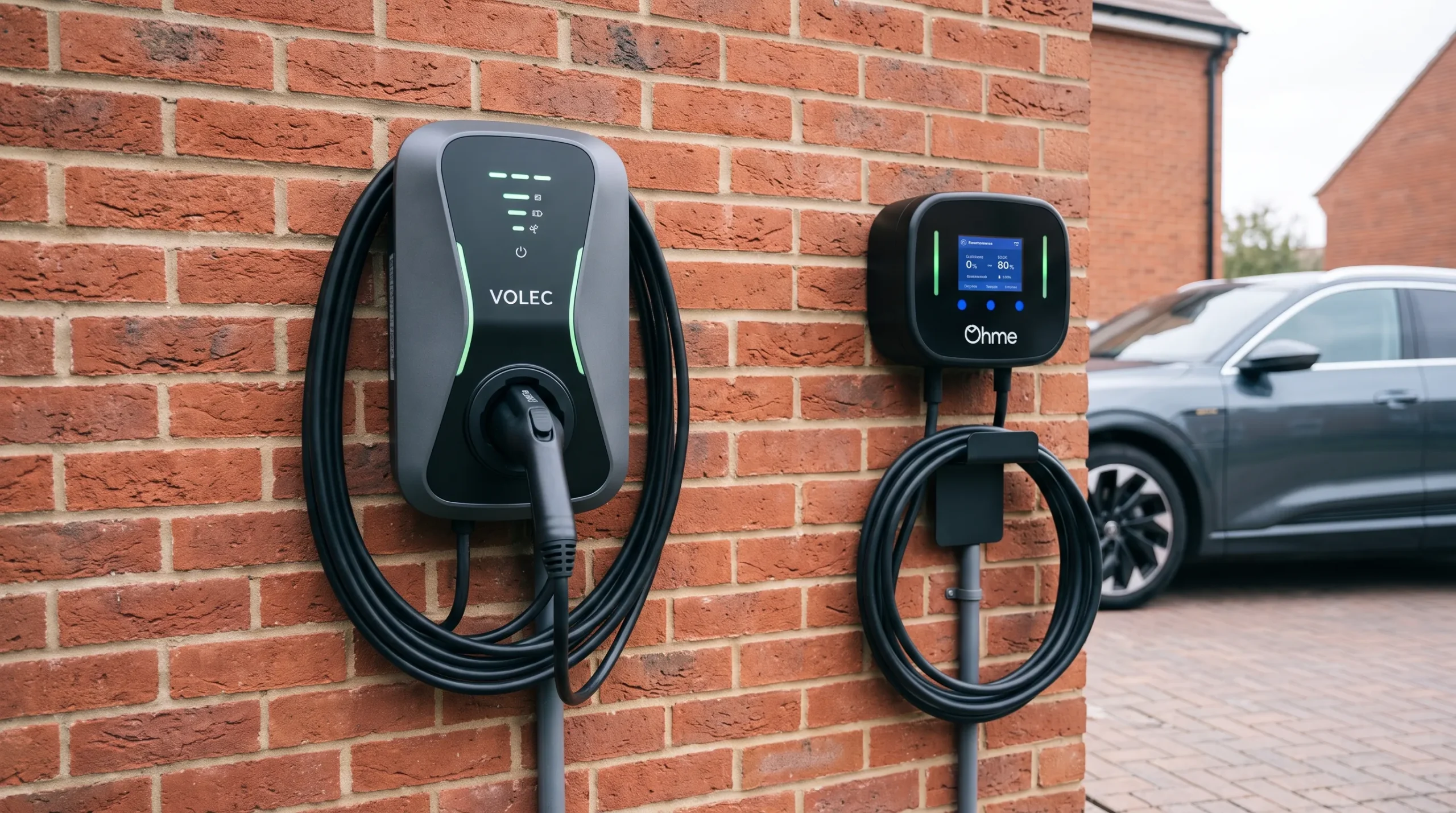
The Ohme Home Pro is a 7.4kW tethered charger from Ohme, a UK company known for its smart charging app. It’s rated at 32 amps on a 230 volt single phase supply, it has the Type 2 plug fixed to a cable, and it’s sold in 5 metre and 8 metre cable versions.
The VOLEC Pulse is our own 7kW smart home charger. It uses a Type 2 connector, works with every EV without favouring one brand, and is built for scheduling around cheap night rates, load management and solar. We sell it direct and connect you with vetted installation partners across the country. The full specification is on the VOLEC Pulse page.
So on paper they sit in the same class. The Home Pro is the better known name. The Pulse is the newer one, and we sell it direct.
Where they match, and where they differ
Power is the same for practical purposes. A 7kW charger adds roughly 25 to 30 miles of range per hour of charging on most cars, so an overnight session of six or seven hours adds well over 100 miles of range. Neither charger will beat that on a single phase supply, because the supply is the limit, not the box on the wall. The guide to 7kW home chargers goes through why.
The Home Pro is the more fully specified unit on paper, simply because Ohme publishes a long datasheet. It has a three colour LED strip, a small screen and three buttons on the front, so you can start or stop a charge without opening the app. It’s built into a UV stabilised case with an IP55 rating, which means it can sit outside in rain and dust, and an IK08 rating for knocks. Ohme gives it an operating range of minus 25 to 45 degrees Celsius. It weighs about 4kg and measures roughly 170 by 200 by 100 millimetres.
The Pulse is controlled from the app, so you set your charging times there. If you like physical buttons and a screen on the wall, that counts for the Home Pro. If you’d rather do everything from your phone, that counts for the Pulse.
How does each one handle cheap electricity?
This is the main reason to buy a smart charger. Many UK suppliers offer cheap overnight rates, and a smart charger starts your car when the price drops and stops when it rises.
Ohme built its name on this. The Home Pro talks to the supplier tariff, works out when your car will be cheapest to charge, and lets you set the time you need it ready. Its datasheet says it integrates with all energy providers, including Octopus and OVO smart EV tariffs. It connects over a built in 3G and 4G SIM, with the first three years of data covered by Ohme, so it doesn’t depend on your home Wi-Fi staying up. It also gets software updates over the air.
The Pulse does the same job from the other end. It’s designed for scheduling around cheap night rates, and you set your charge window in the app. We’d say the Home Pro has the edge on tariff depth, because tariff integration has been Ohme’s focus from the start. If you’re on a smart tariff that needs the charger to talk to the supplier directly, check that the Pulse supports your tariff before you buy. Smart versus standard chargers explains what to look for.
If you’re simply on a fixed night rate and want the car to charge between midnight and 5am, both will do that without any fuss.
“Which one is better with solar panels?”
This is where you need to read the small print on any charger, ours included.
The Home Pro has solar charging, so a driver can use spare generation from their panels. But Ohme’s datasheet says both solar charging and dynamic load balancing need a working CT clamp. A CT clamp is a small sensor that sits on a cable at your meter or consumer unit and tells the charger how much power the house is using or exporting. It’s an extra part, and it has to be fitted and kept working.
That’s not a fault. Most solar aware chargers on the market work the same way. But it’s a question to ask of every charger you look at: does solar tracking need extra hardware, and who pays for fitting it? We cover how solar aware charging works in our solar EV charger guide and the best charger for solar and a home battery post. For the Pulse, the product page is where to check exactly what’s needed for your setup.
If you have no solar, none of this applies to you, and you can skip it.
Load management and your fuse
Most British homes have a limited supply, and a 7kW charger draws a lot of it. If you start the oven, the electric shower and the car at once, something has to give. Load management is the feature that stops the charger from pushing the house past its limit. It watches what the rest of the house is using and turns the car’s charge down to match.
On the Home Pro, dynamic load balancing is there but needs the CT clamp. On the Pulse, load management is part of what the charger is designed for. Either way, the installer should check your supply and consumer unit before fitting anything. Load management is explained in plain words in another of our posts, including when you need it, which matters most where the supply is limited.
Tethered or untethered?
The Home Pro is a tethered charger, so the cable is fixed to the unit and you leave it coiled on the wall. That means no cable in the boot and no fiddling in the rain. It also means you can’t swap in a longer cable later.
Whether you want that depends on how you park. Some people love grabbing the cable and going. Others prefer a socket and their own lead. Our guides to tethered versus untethered chargers and 5m versus 10m cables will help you pick. Measure the distance from the wall to your charge port before you decide, since a cable that’s a metre too short is a common regret.
Who installs them?
The Home Pro is stocked by a number of UK electrical retailers, so you can buy it from a few places and arrange an electrician. Whoever fits it needs to be qualified, and the unit doesn’t include overcurrent protection, so that has to be fitted separately.
With the Pulse, you buy from us and we connect you with a vetted installation partner near you. We don’t fit it ourselves. That keeps the price of the charger separate from the price of the job, so you can see what each costs. The partner checks your supply, your consumer unit and the cable run, and then quotes for the work. The installation page lays out the steps, and the FAQ answers the common questions.
Installation prices vary a lot between homes. A short run from the consumer unit to an outside wall is a smaller job than a long run through a garage. What a charger installation costs in the UK is broken down in our installation cost guide, and you should get at least two quotes whichever charger you choose.
What about the price?
We’re not going to put numbers on the page, because prices change, and a comparison that quotes last month’s price does nobody any good. Check the current price of the Home Pro on Ohme’s site or at a retailer, and check the Pulse on our product page.
What matters more than the sticker price is the full cost. Add the charger, the installation, any extra parts like a CT clamp, and think about what you’ll save on electricity. A charger that costs a bit more but cuts your running costs every month can come out ahead within a couple of years. One that needs extra hardware to switch on a feature you want might cost more than it looked.
Is the Home Pro simply the better charger?
Yes, if you are already on an Ohme linked tariff, or you want a charger from a company with a long record and a big user base, the Home Pro is a safe and sensible choice. It’s well built, it works outside, it connects over its own mobile signal, and the datasheet backs it up with real detail. If you like a screen and buttons on the unit, that’s another point in its favour.
The Pulse makes sense if you want a charger from a brand built around its own product, with buying and installation kept simple, and a unit that handles scheduling, load management and solar without a lot of fuss. It also suits you if you’d like to buy straight from the maker, not through a wholesaler.
If you’ve already read our Ohme ePod, Andersen Quartz and Tesla Wall Connector comparison, you’ll know that one covers the ePod, which is a different Ohme model from the Home Pro. The wider best home EV charger guide puts all of these side by side.
Where it goes on the wall
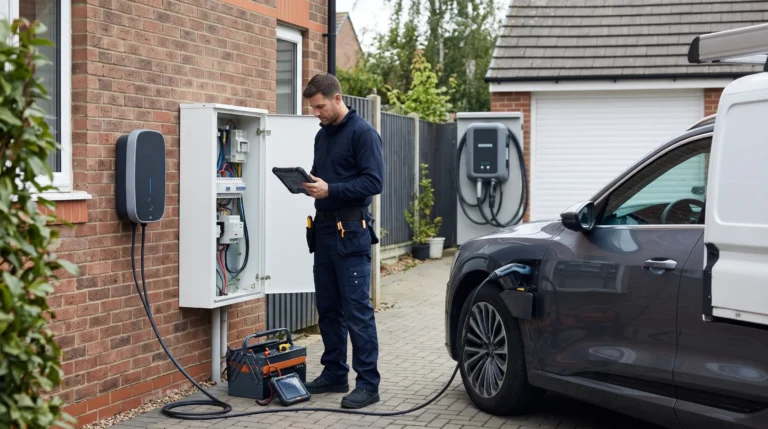
Position matters more than people think. The charger needs to sit near your parking spot, close to the consumer unit if you can manage it, and within easy reach of the charge port on your car. A short run of cable from the fuse box to the unit keeps the install cheaper.
The Home Pro can be mounted on a wall or a post, indoors or outdoors, and the cable enters from the back or the underside. Its IP55 rating covers rain and dust, so a driveway wall is fine. For the Pulse, look at the weather rating on the product page and ask your installer if the spot you’ve picked is sheltered. Neither is something you want hanging in a spot that floods or sits right under a gutter that overflows.
Will it work with your car?
Both chargers use Type 2, the standard plug on current UK electric cars, so the connector isn’t the question. Every mainstream EV sold here, Tesla included, can charge from a Type 2 unit. What differs is how fast your car accepts AC charging. Many cars take 7kW and some take less, and a charger can only give what the car will take. Check your car’s onboard charger rating before you assume you’ll see the full 7kW.
It’s also worth thinking about your next car, not just this one. A charger that works with every make means you aren’t stuck if you change brands. Both of these do.
Updates, support and the years after the first
A smart charger is a small computer on your wall, so it needs software that stays up to date. The Home Pro gets updates over the air, and its mobile data is covered by Ohme for the first three years. That’s a useful detail, and it raises a fair question that you should ask any seller of any charger: what happens to the app, the updates and the connection once those early years are up?
The same question applies to the Pulse, and we’d rather you asked it. Look at what the warranty covers, how long the app is supported, and who you call if the charger stops talking to your phone. Smart features are only as good as the support behind them, and a charger that can’t connect is just an expensive socket.
It also helps to know who you’d deal with. With a charger bought through a retailer, you might go to the shop for some problems and the manufacturer for others, and an installer for the rest. Buying direct from a maker, as with the Pulse, keeps the first point of contact simple, and the installer handles the wiring side. Neither route is wrong. It’s about knowing the answer before something breaks and not after.
Questions to ask before you buy any smart charger
Does it work with my tariff, and who says so? Does solar tracking need extra hardware? What does the installer need to check at my house, and what will they charge? Is the cable fixed or removable, and is it long enough? What happens if the app stops working? How long does the manufacturer support it? And what’s the warranty on the unit and on the installation?
A good seller answers those without dodging. If you get a vague answer, the charger might still be good, but you’ll want that settled in writing before you hand over money. We’re happy to answer them for the Pulse if you get in touch.
Quick Answers
What is the difference between the VOLEC Pulse and the Ohme Home Pro?
Both are 7kW class smart home chargers with a Type 2 connector. The Ohme Home Pro is a tethered unit with a built-in mobile connection, a screen and buttons, and deep tariff integration. The VOLEC Pulse is controlled from its app, sold directly by VOLEC and installed by a vetted partner near you.
Is the Ohme Home Pro a 7kW charger?
It’s rated at 7.4kW and 32 amps on a 230 volt single phase supply. It adds roughly 25 to 30 miles of range per hour, as long as your car accepts that much AC power. A single phase supply is the real limit for any charger in this class.
Does the Ohme Home Pro need a CT clamp for solar?
Yes. Ohme’s datasheet says both solar charging and dynamic load balancing need a working CT clamp. That’s an extra sensor fitted at your meter or consumer unit. Ask any charger seller whether their solar feature needs extra hardware too.
Is the Ohme Home Pro waterproof enough to go outside?
It has an IP55 rating, which covers dust and rain, and an IK08 impact rating. It can be mounted on a wall or a post, indoors or outdoors. Ohme gives its operating range as minus 25 to 45 degrees Celsius.
Does the Ohme Home Pro work with Octopus and other smart tariffs?
Ohme says it integrates with all energy providers, including Octopus and OVO smart EV tariffs. It connects over a built in 3G and 4G SIM, with the first three years of data covered by Ohme. If you’re on a particular tariff, confirm support with the supplier before you buy any smart charger.
Which charger is better for tariff charging?
The Ohme Home Pro is built around tariff integration, so it has the edge if you’re on a smart tariff that needs the charger to talk to the supplier. For a fixed cheap night rate, both chargers can start the charge on a schedule. Check that the Pulse supports your tariff first.
Does a smart charger need Wi-Fi?
It depends on the model. The Ohme Home Pro uses its own mobile SIM, so it doesn’t rely on your home Wi-Fi. For the Pulse, check the product page for how it connects before you decide.
Is a tethered charger better than an untethered one?
A tethered charger keeps the cable fixed to the wall, so there’s nothing to carry or plug in. An untethered one lets you use your own lead and swap it later. The right choice depends on where you park and how far your charge port is from the unit.
Do the Pulse and the Home Pro work with every electric car?
Both use a Type 2 connector, which fits every current UK electric car, Tesla included. The limit is how much AC power your car’s onboard charger accepts. Many cars take 7kW and some take less.
Who installs the VOLEC Pulse?
A vetted installation partner near you fits it. We sell the charger and connect you with the partner, who checks your supply and consumer unit and quotes for the work. A qualified electrician is needed for any home charger install.
How much does it cost to install a home EV charger?
It depends on the distance from your consumer unit to the charger, the state of the consumer unit and any extra parts such as a CT clamp. Our installation cost post breaks down what drives the price. Get at least two quotes whichever charger you choose.
Should you buy the Pulse or the Home Pro?
Pick the Home Pro if you want an established name, a screen and buttons on the unit and deep tariff integration. Pick the Pulse if you want to buy direct, keep the install simple and control everything from the app. Either way, ask what extra hardware your setup needs.
Get a charger that fits your home
Not sure which charger suits your supply, your car and your tariff? Get in touch and we’ll talk it through. Use our contact page, read the FAQ, or look at the full VOLEC Pulse specification.