
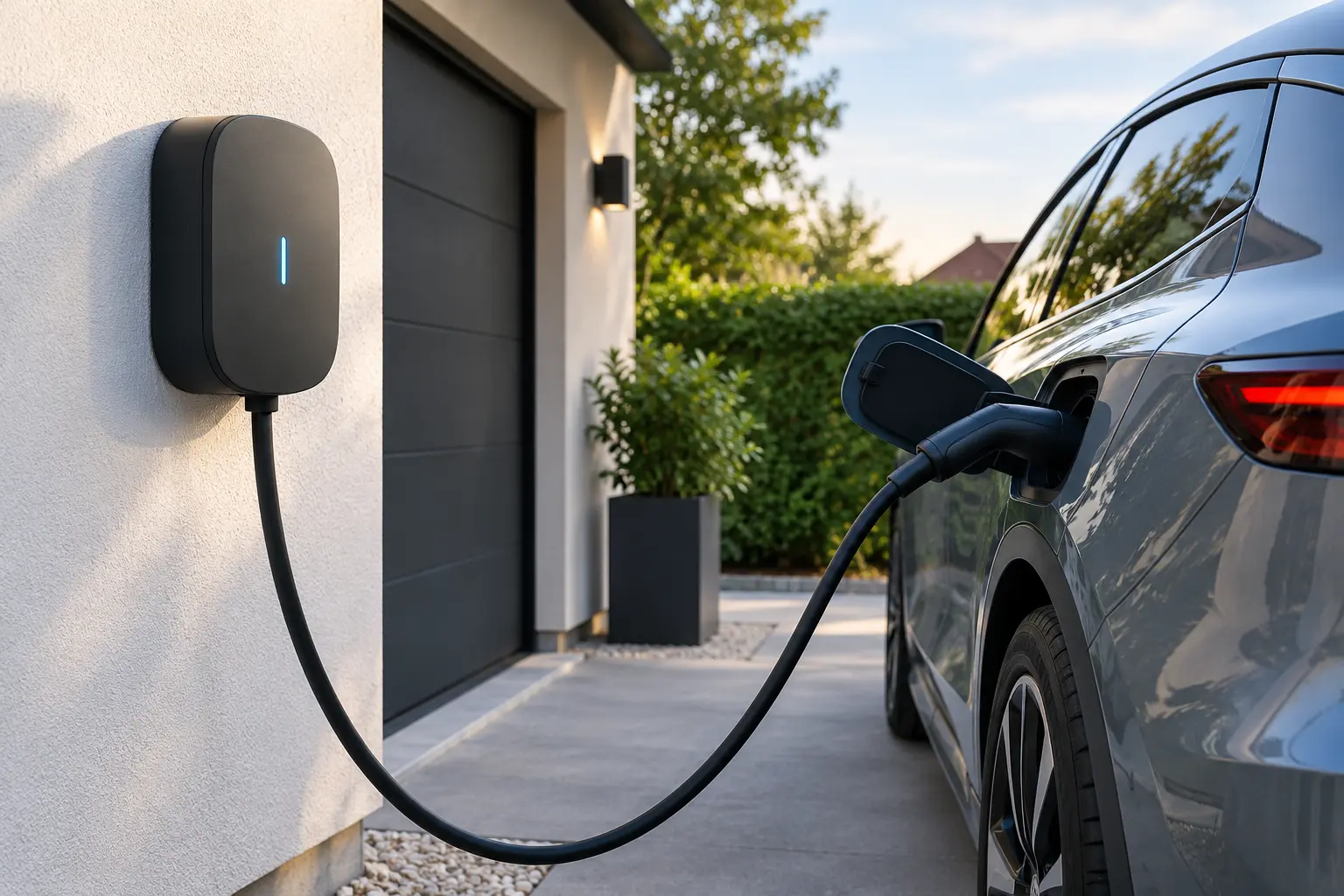
A 7kW home EV charger is enough for almost every UK driver. On a normal single phase supply it delivers up to 7.4kW from a 32A circuit, which adds roughly 20 to 27 miles of range per hour. A typical 60kWh car goes from 20 to 80 percent in about five and a half hours, and a night on the charger refills nearly any EV. The main exception is a car with a small onboard charger. Some cars accept only 3.7kW or 6.6kW from a home charger, so they charge slower than the wallbox could supply, and a faster charger would not change that.
Here is the short test. If you drive under about 100 miles a day and can plug in overnight, 7kW is plenty. If your car has a 3.7kW onboard charger, check that against your daily mileage before you worry about the wallbox. If you have a three phase supply and drive very high mileage, a faster unit might be worth looking at. Everything below explains why.
7kW, ready to fit: VOLEC Pulse 7kW, Type 2, tethered 5m or 10m cable, load management, solar aware, IP66, 10 year warranty. £279 with installation arranged at checkout. See the VOLEC Pulse
The table shows rough charge times from 20 to 80 percent on a 7kW home charger, for three common battery sizes and three onboard charger limits. It allows for about 10 percent lost as heat. Treat the figures as estimates, because cold weather and the battery level both change them.
| Battery size | Car accepts 7.4kW or more | Car accepts 6.6kW | Car accepts 3.7kW |
| About 40kWh | About 3.5 hours | About 4 hours | About 7 hours |
| About 60kWh | About 5.5 hours | About 6 hours | About 11 hours |
| About 80kWh | About 7 hours | About 8 hours | Not a usual pairing |
“How many miles does a 7kW charger add per hour?”
Roughly 20 to 27 miles. A thrifty car lands near the top of that range and a heavy SUV near the bottom.
The sums go like this. A 7kW charger on a 32A circuit supplies up to 7.4kW. After losses, about 6.7kW reaches the battery. A car doing 3.5 miles per kWh turns that into about 23 miles every hour. A thrifty car at 4 miles per kWh gets closer to 27. A heavy SUV at 3 miles per kWh gets about 20.
Put that against a normal day. Say you drive 30 miles. At 3.5 miles per kWh that’s about 8.6kWh, and a 7kW charger puts it back in about an hour and a quarter. You plug in at 11pm and it’s done before you’ve brushed your teeth.
“Does my car’s onboard charger limit the speed?”
Yes, and this is the part most buyers miss.
Home charging is AC power. Your car has an onboard charger that converts it to DC for the battery, and that charger has a ceiling of its own. The speed you get is the smaller of two numbers: what the wallbox supplies, and what the car will accept.
Plenty of modern EVs accept 7.4kW or more from a home supply. Some older or smaller cars stop at 6.6kW, and some at 3.7kW. A few cars list 11kW, but that needs three phase power, and on a normal single phase home they still take only 7.4kW. Buy a faster wallbox than the car can use and you get exactly nothing for the extra money.
Look up your car’s maximum AC charging rate in the manual or on the manufacturer’s UK spec sheet. It can differ between trims of the same model, so check the exact version you drive.
Two examples that show the difference
Take two example drivers. Priya drives a car with a 40kWh battery and a 3.7kW onboard charger. She commutes 50 miles a day. That needs roughly 14kWh, which takes her about four hours to charge. Comfortable. If she wanted a full charge from near empty, she’d need around 11 hours, so she’d plan for a long night.
Dan drives a 77kWh car that accepts 7.4kW. He does 40 miles a day, and every weekend he runs it down to 10 percent before a long drive. His weekday top up takes under two hours. His weekend refill from 10 to 100 percent needs about 69kWh into the battery, and that’s roughly ten and a half hours on a 7kW charger. He plugs in at 8pm and it’s full by 6:30am.
Neither of them needs a faster charger. Priya’s car couldn’t use one anyway.
“Will a 7kW charger fill my car overnight?”
For nearly every car, yes.
A cheap night tariff window is often around six hours. Intelligent Octopus Go, for example, gives your EV up to six hours of smart charging at its off peak rate each day. Six hours at 7.4kW puts about 40kWh into the battery after losses, which is roughly 140 miles at 3.5 miles per kWh. A car that only accepts 3.7kW would take about 20kWh in the same window, around 70 miles.
Most drivers use a fraction of that each day. Even on days when you’ve driven a lot, the next night’s charge usually catches up.
When is 7kW not enough?
Rarely, but there are a few real cases.
The first is very high mileage. If you cover 200 miles a day regularly, such as a taxi or a delivery driver, you need about nine hours of 7kW charging every day to replace it. That leaves no slack, so you’ll lean on rapid chargers on the road.
The second is a business or fleet with several vehicles sharing a supply. One 7kW point per van is fine if each van sits for ten hours, but not if they all turn around in three.
The third is a three phase home with a car that accepts 11kW or 22kW. There, a faster unit gives real gains. Most UK houses have single phase, so most buyers can ignore this. Your electricity supplier or installer can tell you which supply you have.
Outside those cases, paying more for a faster unit rarely saves you anything. For anyone looking at the wider choice, the buyer’s guide to the best home EV charger in the UK covers the other features worth comparing.
Why you might not get the full 7kW
Several things can bring the speed below the headline number.
Your car’s onboard charger is the main one, as covered above. After that comes your home’s electricity supply. A 7kW charger draws about 32 amps, and if other appliances are running, a charger with load management lowers its own output to protect your main fuse. A shower and an oven on at the same time will cost you some charging speed until they switch off. It’s normal, and it keeps you inside your supply limit.
Solar changes the speed too. A solar aware charger can run in a mode that follows your surplus panel output. On a cloudy afternoon that surplus may be well under 7kW, so the car charges slowly. If you need speed, check that your charger has a mode that tops up from the grid.
Cold weather and a nearly full battery both slow AC charging slightly, because the car spends some energy warming the battery, and it eases off near the top.
Not sure if your home supply can handle a 7kW charger? VOLEC includes a free panel check before installation. Start your free panel check
Is 7kW the same as 7.4kW?
Close enough. A home charger sold as 7kW runs at about 7.4kW at full power, which is 32 amps at 230 volts. The two numbers describe the same charger. The lower number is the marketing name, and the higher is what your car sees when everything is running at the limit.
You may also see 3.6kW chargers, which are 16 amps. They exist, and they cost a little less, but they take about twice as long. For a home you’ll live in for years, the saving is rarely worth it, unless your car only accepts 3.7kW anyway.
7kW or 11kW: which one?
For a single phase home, 7kW. An 11kW charger needs a three phase supply, and few houses have one. Upgrading a supply to three phase can cost a lot, and the work involves your network operator. Unless you have a clear need for that speed, the money does more good in a better charger on your current supply.
If your home already has three phase power and your car takes 11kW, then an 11kW unit would roughly cut your charging time by a third compared with 7kW. Check both before you decide.
Tethered or untethered at 7kW?
It doesn’t change the speed. Both types charge at the same rate, because the cable setup has no effect on how fast your car fills. If you’re deciding between them, we’ve covered it in our guide to tethered vs untethered EV chargers.
What it costs to run a 7kW charger
The cost is the electricity going into your car, and that comes down to your tariff. A standard rate at the Ofgem price cap is about 26p per kWh from 1 October 2026. On a night EV tariff, rates around 7 to 9p per kWh are common, with Intelligent Octopus Go at around 7.6p between 11:30pm and 5:30am.
That 30 mile daily drive needs roughly 8.6kWh in the battery, or about 9.5kWh from the grid once charging losses are counted. At 26p that’s about £2.50. At 7.6p it’s about 72p. Over a year of daily driving, the gap adds up to several hundred pounds. Tariffs change often, so check the supplier’s page before you switch.
Where the VOLEC Pulse fits
The VOLEC Pulse is a 7kW smart home charger at £279, with installation arranged at checkout. It has adaptive load management, solar aware charging, an IP66 casing, app scheduling over Wi-Fi, over the air updates and a ten year warranty covering parts, labour and the electrical connection.
It suits homes with one or two EVs, a driveway or garage wall, and a normal single phase supply. Run the free panel check first if your supply is tight, because it tells you what the house can run before you pay for anything. Questions about your own setup can go through the contact page, and the installation steps are on the installation page.
Three mistakes to avoid
Paying extra for a faster wallbox without checking what the car accepts.
Assuming 7kW means 7kW all the time, when the car, the supply and the weather all have a say.
Skipping the supply check, then finding out the house can’t take a 32A circuit.
Frequently asked questions
Is a 7kW home EV charger enough?
Yes, for almost every UK driver. A 7kW home EV charger can add roughly 20 to 27 miles of range per hour and can refill most EVs overnight on a typical single-phase domestic supply.
How long does a 7kW charger take to charge an electric car?
Charging time depends on your battery size and the amount of charge you need. A 60kWh battery can take around 5.5 hours to charge from 20% to 80% if the vehicle accepts 7.4kW. A 40kWh battery may take around 3.5 hours, while an 80kWh battery may take around 7 hours under similar conditions.
Can my car use all 7kW from a home charger?
Only if your car’s onboard AC charger can accept 7.4kW or more. Some EVs are limited to 6.6kW, 3.7kW or another lower charging rate, so they will charge at their maximum supported speed even when connected to a 7kW home charger.
Is it worth getting an 11kW charger instead of 7kW?
Usually only if your property has a suitable three-phase electricity supply and your EV supports 11kW AC charging. On a typical single-phase UK domestic supply, an 11kW charger cannot deliver more than around 7.4kW.
How many miles per hour does a 7kW charger add?
A 7kW home charger typically adds around 20 to 27 miles of range per hour. For example, an EV achieving around 3.5 miles per kWh could gain roughly 23 miles of range in an hour. Actual range added varies depending on the vehicle, driving efficiency and charging conditions.
Why is my 7kW charger not charging at 7kW?
There are several possible reasons. Your car may have a lower onboard charging limit, or load management may reduce charging power when other appliances are using electricity. Solar surplus charging, cold weather and a battery that is close to full can also reduce the charging rate.