
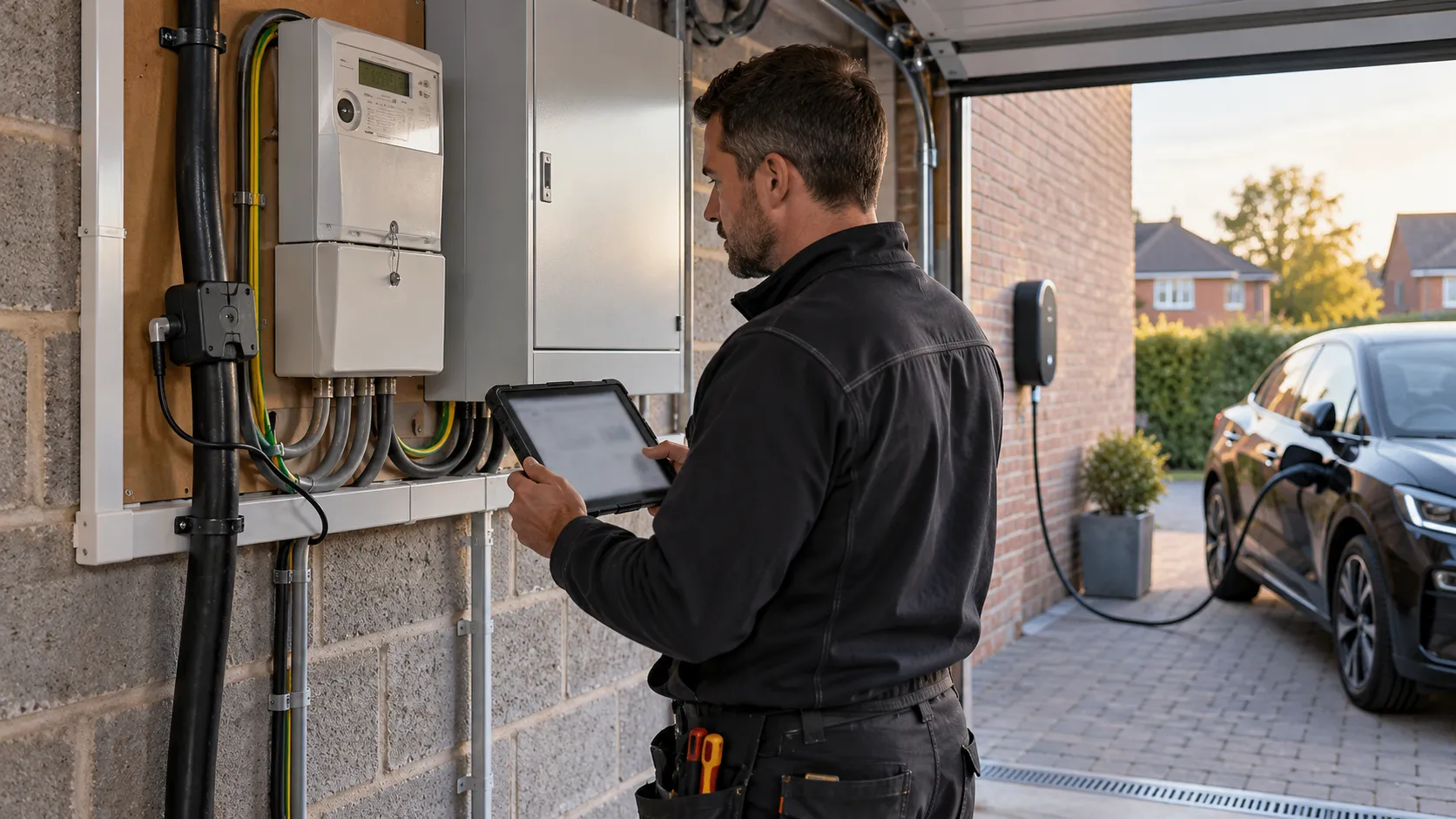
EV charger load management is a feature that lets your charger lower its own speed when the rest of the house is using a lot of power, so the home never asks for more than its supply can safely give. A 7kW charger draws about 32 amps, and plenty of UK homes have a main fuse of just 60A, 80A or 100A. On a busy evening, a shower, an oven and a charger running together can come close to that limit. With load management the charger notices, eases off for a while, and speeds up again when the house goes quiet. You stay inside your supply and still charge as fast as the spare capacity allows.
Whether you need it depends on your fuse and on what else you run at the same time. A 100A supply and a gas boiler may never come near the limit. A 60A supply with an electric shower is a different story. Your installer should check which one you’ve got before they quote.
Load management built in: VOLEC Pulse 7kW, Type 2, tethered 5m or 10m cable, adaptive load management, solar aware, IP66, 10 year warranty. £279 with installation arranged at checkout. See the VOLEC Pulse
“How does EV charger load management work?”
The charger has to know how much power the house is using, and it can only know that if something measures it.
Most home setups use a small clamp, called a current sensor, that goes around the main supply cable and reads the total current coming into the property. The charger looks at that reading every second or so and changes its output a few seconds later. A kettle clicking on for a minute usually doesn’t make it react, because chargers tend to smooth out the reading. A shower and an oven running together will.
That’s the whole trick. Read the house, subtract it from the limit, charge with whatever’s left.
Why a 7kW charger can be a problem for an ordinary house
Start with the supply. Where the cable from the street enters your house there’s a main fuse, and in UK homes it’s usually 60A, 80A or 100A. Older properties often have the smaller sizes. That fuse belongs to your network operator, not to you or your electrician.
Now the charger. A 7kW unit needs a 32A circuit to itself. On a 60A supply, that one appliance can use more than half of everything the house is allowed to draw.
Then add an evening. On a standard list of appliance ratings, a single oven is about 13A, a kettle up to 13A, a dishwasher 10A and a washing machine 10A. Together that’s around 46A, with the lights and the telly still to come. An electric shower is often rated somewhere between 8kW and 10kW, which is more than any of those on its own. Put a 32A charger on top and you could be asking for well over 60A.
Real life is kinder than the list. The oven isn’t always at full power, and the kettle is only on for three minutes. But evenings come closer to the limit than most people expect, and a fuse that’s asked for too much too often is not something you want to find out about at 7pm on a Friday.
“Is load management better than getting a bigger main fuse?”
They solve the same problem from opposite ends, and plenty of homes end up using both.
A bigger main fuse means more headroom. The upgrade is done by your network operator, who may do it for free or for a fee, and the answer changes from area to area. It can take a few weeks. You’ll need to ask them what yours would cost, because installers can’t answer that for you.
Load management is the quicker fix, and it’s part of the charger. It doesn’t give your house more power. It just stops the charger fighting the rest of the house for what’s there.
If you’ve got a 60A supply you can’t upgrade soon, load management is what lets you fit a 7kW charger at all. If you’ve got a good fuse already, it’s a safety net you may rarely notice.
Static or dynamic?
There are two kinds, and they’re not the same thing.
Static load management sets a fixed maximum when the charger is installed. Say your installer decides the charger should never draw more than 20A. It will hold that limit whatever else is going on. It’s simple, it works, and for one charger on a generous supply it can be enough. The downside is that it’s cautious all the time, even at 3am when the house is asleep and there’s plenty of room.
Dynamic load management changes the limit in real time. At 3am it can run flat out. At 7pm when the cooker is on it backs off. This is the one that reads your supply with a sensor, and it’s what most people mean when they say “load management”.
“Will load management slow my charging?”
Sometimes, and usually less than you’d think.
Take a Tuesday. You get home at 6.30pm and plug in. The oven’s on, the washing machine’s running, and someone’s in the shower. For the next hour the charger might sit at half speed or less. By 9pm the oven is off, the shower’s quiet, and it climbs back to full power. By the time you’re asleep it’s doing everything it can.
Most of your charging happens overnight, when the house is nearly silent, so you lose very little over a whole night. If you charge on a cheap night tariff, the charger spends most of its time at or near full speed.
There is a floor. Chargers generally can’t run below about 6A, which is roughly 1.4kW. If the house is using almost everything the supply allows, the charger may pause until it can start again at that minimum. Speed can vary for other reasons too, like what your car’s own onboard charger accepts, and our post on whether a 7kW home EV charger is enough goes through those.
“Do I need load management if I have a 100A fuse?”
Maybe not.
A 100A supply has far more room, and one charger alongside normal household use may never come close to the limit. In that case a charger with a fixed maximum, the static kind, could be all you need. The installer should look at your fuse and at what you run before deciding.
It’s worth having the dynamic kind anyway if you’re planning changes. A heat pump, a second EV or an electric shower will all eat into your headroom later, and a charger that adjusts itself won’t need anyone to come back and reset it.
What the installer actually checks
A good installer doesn’t just look at the charger. They look at the house.
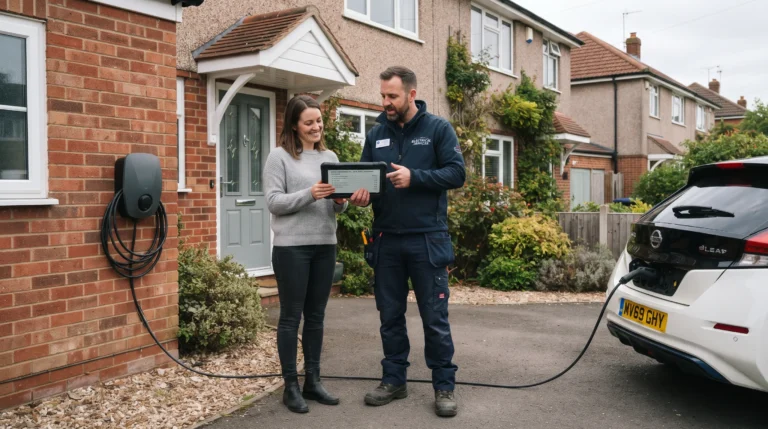
That means finding out the size of your main fuse, how far the charger will sit from your fuse box, what else is on the supply, and whether your consumer unit has room and the right protection. The result is a decision about how much the charger can draw, which is then set during installation.
VOLEC does part of this before anyone visits. Every order includes a free panel check. You answer a few questions about your electrical panel, or upload a photo of it, and it tells you the amperage you can safely run before you pay for anything. The steps are on the installation page.
Not sure if your home supply can handle a 7kW charger? VOLEC includes a free panel check before installation. Start your free panel check
A quick example shows why this matters. Two neighbours buy the same charger. One has a 100A fuse, gas heating and a gas hob. The other has a 60A fuse, an electric shower and an electric oven. The first can fit the charger and forget about it. The second needs it limited, either by a fixed setting or by a charger that reads the house. Same street, same charger, different answer.
Is load management a legal requirement?
No.
The Smart Charge Point Regulations in Great Britain require smart functions, default off peak charging hours, a short random delay and security measures. Load management isn’t on that list. So a charger can be fully legal and still not have it, and some basic units leave it out. It’s one of the real differences between a charger that meets the legal minimum and one with a full set of features. We cover that gap in our post on the difference between a smart and a standard EV charger.
Load management and solar panels
Both ideas start from the same thing: reading what the house is doing.
Load management looks for a limit and stays under it. Solar aware charging looks for spare power and uses it. A charger can do both at once, and how the second one works, including the 1.4kW minimum and the modes you’ll see, is in our post on solar aware EV charging.
What to ask before you buy
Charger pages tend to say “load management” and stop there. A few questions will tell you much more.
Is it static or dynamic? Dynamic reacts to your house in real time. Static holds one fixed limit.
Does it need a sensor, and is that included? Some systems need a clamp fitted by an electrician on the same visit, and you want to know whether it’s in the price.
How low will it go? Ask what the minimum charging speed is, and what happens when the house is using nearly everything.
What if the sensor stops working? A good charger drops to a safe low current rather than carrying on at full speed. Ask, because brands differ.
Can you change the limit later? VOLEC says the charging current can be adjusted through the app, with the safe maximum set during installation. That’s the sort of answer you want to hear.
Where the VOLEC Pulse fits
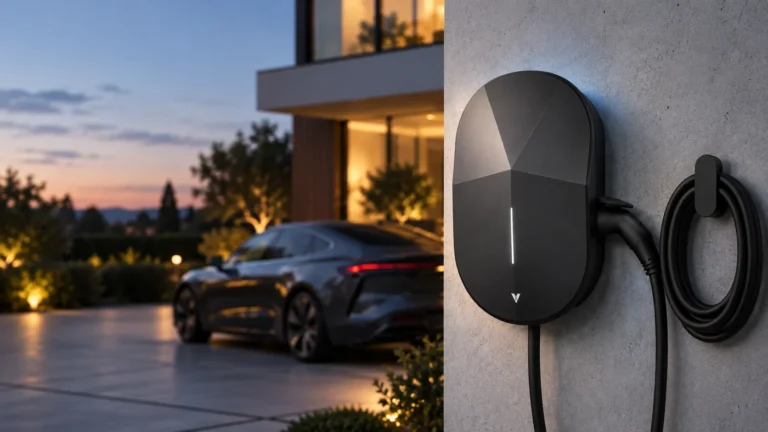
VOLEC says the Pulse reads your panel in real time and backs off automatically when the rest of the house draws more power. It’s a 7kW smart home charger at £279, with installation arranged at checkout, solar aware charging, app scheduling over Wi-Fi, over the air updates, an IP66 casing and a ten year warranty covering parts, labour and the electrical connection.
It suits older homes, smaller supplies and anyone who runs a few big appliances in the evening. If you’re still comparing chargers, the buyer’s guide to the best home EV charger in the UK sets load management beside everything else worth checking.
Quick answers
What is load management on an EV charger?
It lets the charger lower its speed when the rest of your house is using a lot of power, so the home stays inside the limit of its supply. The charger speeds up again when the load drops.
Do I need load management for a home EV charger?
It depends on your supply. It matters most on a 60A or 80A main fuse, in a home with big appliances like an electric shower, and where you plan to add a heat pump or a second EV. Your installer should check your fuse before quoting.
Will load management slow my EV charging?
Sometimes, while the house is busy, such as in the early evening. Overnight the charger usually runs at or near full speed because the house is quiet.
What is the difference between static and dynamic load management?
Static load management holds one fixed maximum set at installation. Dynamic load management changes the limit in real time as your household use goes up and down.
Can a 7kW charger be installed on a 60A main fuse?
Sometimes. Load management can limit the total draw so the supply isn’t overloaded, but your installer has to assess your supply first. A larger fuse from your network operator is another option.
Is load management required by law?
No. The Smart Charge Point Regulations require smart functions, default off peak charging, a random delay and security, but not load management. Some basic chargers leave it out.

Pingback: Best EV Charger for Solar and Home Battery in the UK