
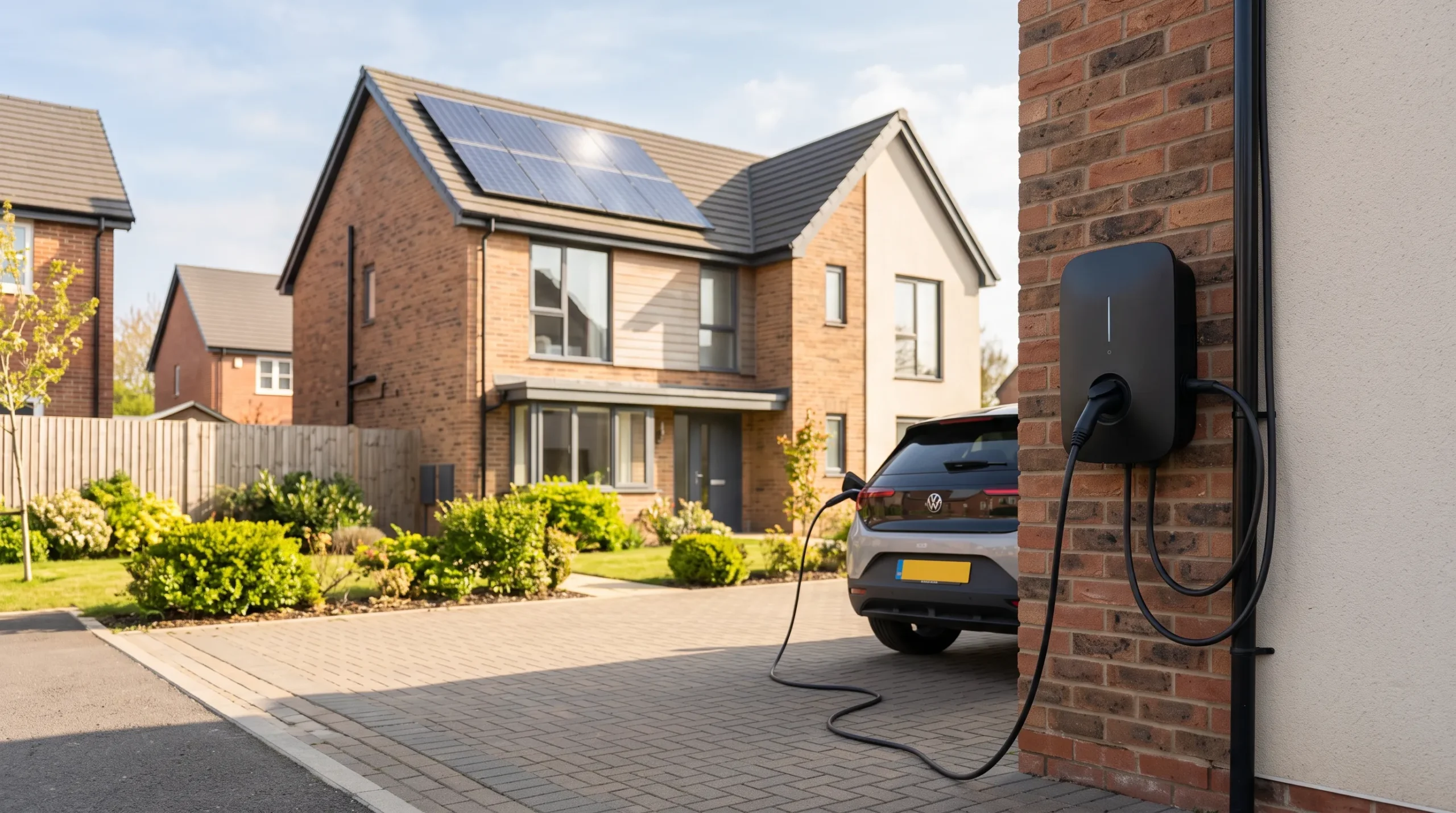
A solar aware EV charger uses your spare solar power to charge the car. It keeps an eye on what your panels are making and what the house is using, and whatever is left over goes into the battery instead of out to the grid. That spare power is worth about 26p a kWh to you at the Ofgem price cap from 1 October 2026, while most suppliers pay around 5p to buy it back. There is one catch. Most chargers need about 1.4kW of spare power before they’ll start, and the sun has to be out while the car is parked at home. So this works best in spring and summer, for people who are around in the daytime.
If your car leaves at 8am and gets back at 6pm, most of your solar charging will happen at weekends. That’s still worth having. But on weekdays a cheap night tariff will do more for you, and plenty of solar owners end up using both.
Solar aware and ready to fit: VOLEC Pulse 7kW, Type 2, tethered 5m or 10m cable, solar aware charging, load management, app scheduling, IP66, 10 year warranty. £279 with installation arranged at checkout. See the VOLEC Pulse
“How does the charger know there’s spare power?”
It needs two readings at the same moment: what the panels are producing, and whether power is flowing into the house from the grid or out of it.
Some chargers get that from a clamp that goes around the main supply cable. Others talk to the inverter directly. Either way, the moment the reading shows power heading out to the grid, the charger knows there’s a surplus and turns its charging current up to catch it. When the oven or the kettle comes on and the surplus shrinks, it turns the current back down.
This happens every few seconds, all day, without you doing anything. You plug in and forget about it.
“Why won’t my charger start when there’s a bit of sun?”
The 1.4kW floor.
A home charger can’t normally run below about 6 amps, which on a 230 volt supply works out to roughly 1.4kW. Spare power under that has nowhere to go, so it carries on out to the grid and the charger sits on standby. There’s no halfway. It either runs at the minimum or it doesn’t run. On a bright June afternoon you’ll be well above the line for hours. On a grey February day you might never reach it.
Chargers handle this in different ways, and every brand names its modes differently. A solar only mode charges purely from surplus and pauses whenever it drops under the line. You get the most solar and the least predictable charge. A mixed mode follows the sun but pulls a small top up from the grid, so a passing cloud doesn’t stop the session. A full power mode ignores the sun and charges at the maximum. Not every charger has all three, so look at what yours offers before you order.
Summer, winter and a car that’s never home
Start with the panels. A typical UK home has a 3kW to 4kW system, and a 4kW one makes somewhere around 3,400 to 4,200 kWh over a year. That sounds like a lot until you look at when it arrives. In central England a 4kW system might produce roughly 470kWh in June and about 100kWh in December. Spread over the days, that’s around 15kWh on a good June day and a little over 3kWh on an average December one. June gives you four or five times what December does.
Then the car, which only soaks up solar if it’s plugged in at home while the sun is shining.
Say you work from home three days a week. The car sits on the drive, the midday sun tops it up, and between spring and autumn you might cover most of your driving that way. Now say you commute 40 miles each way and the car spends the day in an office car park. Your weekdays get almost nothing, and the solar charging happens on Saturday and Sunday, if the weather plays along.
December is the hard month. With 3kWh or so for the whole day, the surplus rarely clears 1.4kW for any length of time, so winter solar charging is mostly theory.
The winter plan is a boring one. Charge overnight on a cheap tariff. Intelligent Octopus Go sits at around 7.6p a kWh between 11:30pm and 5:30am, against about 26p at the price cap. A lot of solar homes run on sunshine from spring to autumn and on a night tariff for the rest of the year, and a charger that can both schedule and read solar covers the two.
“Is it better to charge the car or sell the power back?”
Usually the car.
The Smart Export Guarantee pays you for what you send to the grid. Larger suppliers have to offer it, and the rates are all over the place. Plenty sit between 1p and 5p a kWh, some go higher, and the best ones tend to need a battery or a particular supplier. Take 5p as a fair average for a quick sum. Grid electricity is about 26p at the price cap, so every kWh you put in the car saves you roughly 21p more than you’d earn by exporting it.
Here’s a worked example. Your panels send 2.5kW to the grid for four hours around midday. That’s 10kWh. After charging losses about 9kWh reaches the battery, which is roughly 30 miles in a car that does 3.5 miles per kWh. Exported at 5p, that surplus earns you 50p. Used in the car, it saves the £2.60 you’d have paid the grid for the same energy.
If you’re on a generous export tariff the gap closes, so run the sum with your own supplier’s rate.
Stretch it over a year and it gets more interesting. A car doing 8,000 miles at 3.5 miles per kWh needs about 2,300kWh in the battery, which is nearer 2,500kWh from the grid once you count the losses. Say solar covers a third of that. You’ve skipped buying roughly 850kWh, and at 26p that’s about £220. It’s an example, not a promise, because your own third could easily be a fifth or a half.
“Will charging the car cut my export payments?”
A little, yes. Every kWh that goes into the car is a kWh you’re not sending to the grid, so the cheque from your supplier gets smaller. At today’s rates that’s a trade worth making, since the car saves you about 26p for each kWh and the grid would have paid around 5p.
If you’re not sure you’re signed up for the Smart Export Guarantee at all, ask your supplier. It usually needs an export meter and an MCS certificate for the panels, and plenty of people with solar never claimed it.
What actually has to be fitted
A charger that can read your solar system. Usually that means a sensor on the supply cable, or a link to your inverter, and the details change between charger brands and inverter brands. Some chargers only work with certain inverters. Some may need a sensor fitted by the electrician during the same visit as the charger.
Ask before you buy. VOLEC’s own FAQ says the exact solar behaviour and the compatibility with your solar or inverter system should be confirmed before installation, and that’s good advice for any brand.
Already have solar panels? Tell us your inverter model before you order. VOLEC includes a free panel check before installation, so you know what your home can run. Start your free panel check
Small habits that help
Plug in as soon as you’re home on a sunny weekend, not after lunch. Surplus tends to peak around midday, so an early start catches more of it.
Watch what else is running. The dishwasher, the oven and the washing machine all eat into the surplus. If you want the car to take as much sun as it can, run the big appliances a bit earlier or later.
Keep a night schedule as a safety net. If you need the car on Monday morning and Sunday turned out cloudy, a scheduled overnight charge on a cheap tariff fills the gap, and you never depend on the weather for a car you have to drive.
And think about what the car needs to do tomorrow. If it’s a 20 mile day, relax and let the sun do it. If it’s 80 miles, switch to full power and stop worrying about the savings for one night.
“I’ve got a home battery. Does this still make sense?”
It does, though the battery and the car now want the same surplus, so one of them has to go first.
A battery can hold the midday surplus for the evening, which helps if the car is out all day. The car can then charge overnight from the grid on a cheap tariff while the house runs on stored sun at peak times. Some systems let you set the order, house first, then battery, then car. Not every battery and charger pair talks to each other, so check that before you buy both.
With no battery at all, the car is your battery. Charging it at midday stores your solar as miles.
“Do I need solar panels to buy one?”
No. Without panels it works like any smart charger, with scheduling and an app, and the solar feature has nothing to read until you add some. Plenty of people buy one in advance. The other smart features are covered in our post on the difference between a smart and a standard EV charger.
What solar doesn’t change
Your fuse box has the same limit it always had. A charger on full power still pulls about 32 amps, and load management is what protects your main fuse when the oven goes on at the same time. If you’re wondering how fast the car will actually fill, our post on whether a 7kW home EV charger is enough goes through it.
Cable choice makes no difference to solar charging. If you haven’t picked one yet there’s a guide to tethered vs untethered EV chargers, and the buyer’s guide to the best home EV charger in the UK covers everything else worth comparing.
Where the VOLEC Pulse fits
The VOLEC Pulse is a 7kW smart home charger at £279, with installation arranged at checkout. It has solar aware charging, which detects surplus solar production and shifts charging to match it. It also has adaptive load management, app scheduling over Wi-Fi, over the air updates, an IP66 casing and a ten year warranty covering parts, labour and the electrical connection.
It suits a home with solar panels, a driveway or garage wall, and a car that’s home on at least some sunny days. If you want to know how it will work with your inverter, ask us through the contact page before you order. The installation steps are on the installation page.
Quick answers
How does a solar aware EV charger work?
It measures how much power your panels produce and how much your house uses, then sends the surplus into the car instead of exporting it. It adjusts the charging current every few seconds as the sun and your appliances change.
What is the minimum solar surplus needed to charge an EV?
About 1.4kW, which is 6 amps at 230 volts on a single phase supply. Below that the charger generally can’t run a session, and a mixed mode adds a little grid power to keep it going.
Can I charge my electric car with solar panels only?
Yes, in a solar only mode, but it only works when the sun is out and the car is home. Cloudy days and winter give much less.
Is it worth charging my EV from solar instead of exporting?
Usually yes. Grid electricity costs about 26p per kWh at the Ofgem price cap, while many export rates sit between 1p and 5p. Check your own supplier’s rate.
Do I need solar panels to use a solar aware charger?
No. It works as a normal smart charger without panels, with scheduling and app control, and the solar feature is ready if you add panels later.
Can I combine solar charging with a cheap night tariff?
Yes. Many solar homes use surplus in the sunny months and a night tariff such as Intelligent Octopus Go, at around 7.6p per kWh, in winter.

Pingback: How Much Does EV Charger Installation Cost in the UK?