If your charger will sit close to your charge port and you park the same way every time, 5m will do the job. If the port ends up at the far end of the car from the charger, or you share the drive with a second EV, you want 10m. And if you honestly can’t decide, take the 10m. A cable that’s a bit too long just gets coiled up. One that’s too short gets on your nerves every single evening.
The tricky part is that “close to the port” depends on three things: where your car’s charge port is, how you park, and where the charger goes on the wall. Ten minutes with a tape measure sorts all three out, and that’s what this guide walks you through.
It’s worth doing properly because a tethered charger has its cable built in. You can’t just swap it for a longer one next month.
The quick version
| If this sounds like you | Go for |
| The port faces the charger and you park the same way every time | 5m |
| The charger is right beside or in front of the car | 5m |
| The port is at the far end of the car from the charger | 10m |
| The charger is on the side of the house, a few metres from where you park | 10m |
| You’ve got two EVs with ports in different places | 10m |
| Your parking changes from day to day | 10m |
| You might swap cars in the next few years | 10m |
Land in both columns? Pick 10m.
First, find your charge port
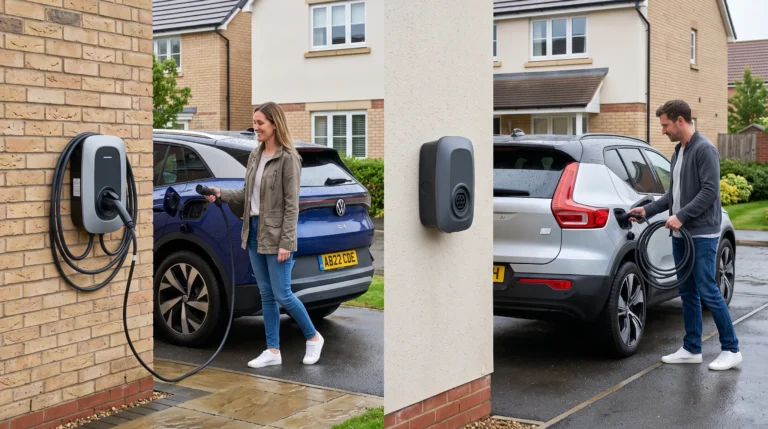
Not every car has its port in the same spot. One UK guide that tracks more than 150 electric cars found about 41% have it at the rear left, 29% at the rear right and 28% at the front. So a back corner is the most common, but a lot of well known models have it up front.
Why does that matter? Imagine your charger is on the wall at the back of the drive. If your car reverses in and the port is at the rear, the port ends up almost touching the wall. Easy. But if the port is at the front and you still reverse in, the cable has to travel the whole length of the car. That’s the moment a 5m cable starts to look short.
Not sure where your port is? Walk out and look, or check the owner’s manual. And if a new car is on the way, check its port before you pick a cable.
Then, be honest about how you park
Forget your best parking day. Think about a wet Tuesday, you’re tired, and the kids are shouting from the back seat.
Do you reverse in or drive in? Do you hit the same spot every time, or roughly the same spot? If it’s roughly, that’s a point for 10m, because a longer cable means you can nudge the car along without getting back in to move it.
Two cars change the sums too. One might have its port at the rear left and the other at the front. One charger on one wall has to reach both, and the cable is what makes that work.
Now measure it
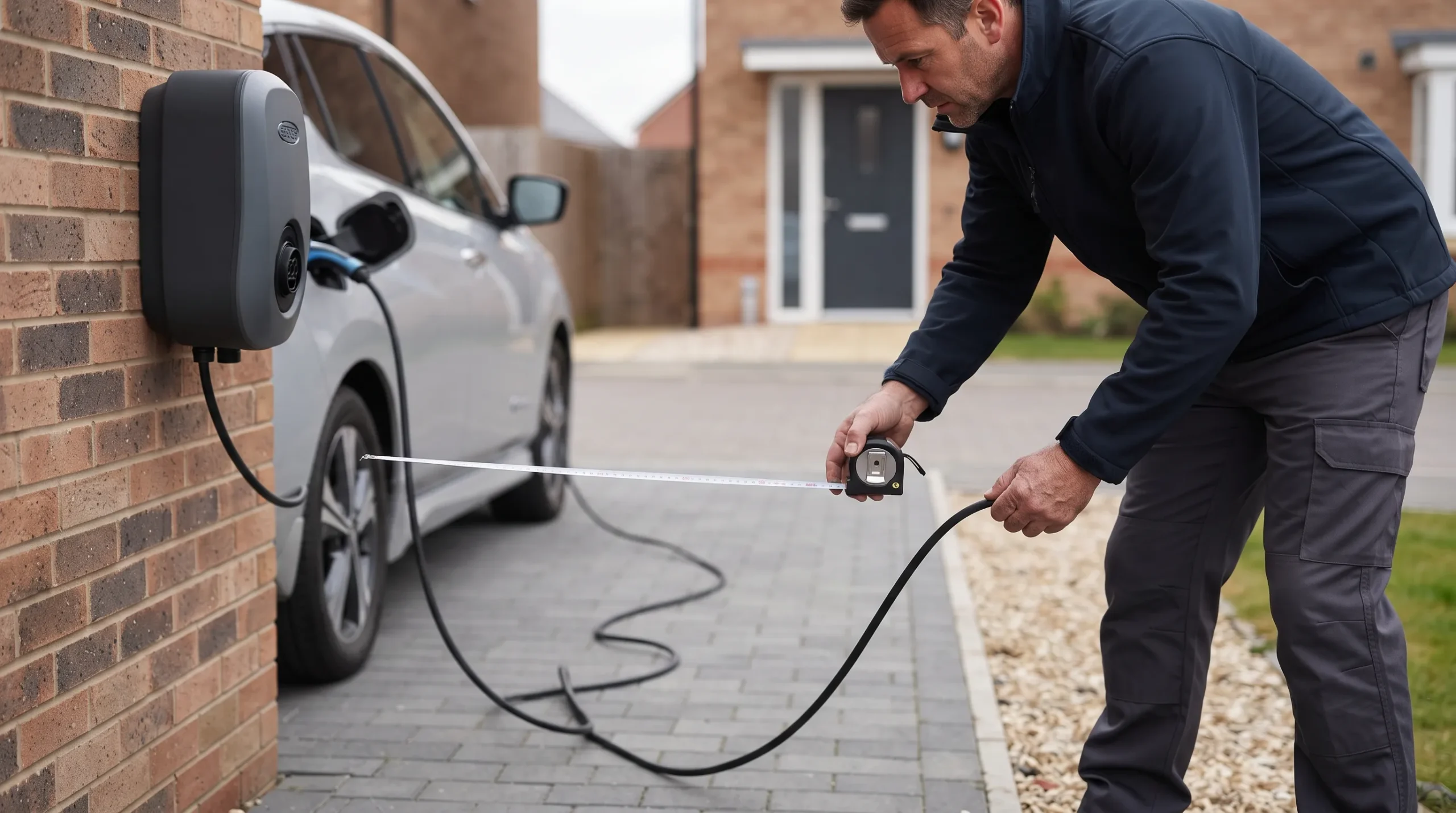
Grab a tape measure and a cup of tea. This takes about five minutes.
Pick a rough spot for the charger (your installer will confirm the final position). Park the car the way you normally do. Then run the tape from the charger spot to the charge port, following the path the cable would really take, around the bumper or along the side of the car. Don’t measure through the car, because the cable can’t go through it.
Add about a metre for slack. A cable pulled tight is under strain, and you’ll want a bit of give. Then repeat for any other way you park.
A worked example
Say your charger is on the front wall of the house, and your car is about 4.5m long. You reverse onto the drive, and the port is at the front.
The cable has to cover roughly 1m from the wall, then 4.5m along the car, plus the 1m of slack. That’s about 6.5m. A 5m cable can’t manage it. A 10m cable can, with room to spare.
Now change one thing: you drive by nose first. The port is about 1m from the wall, so with slack you need around 2m. A 5m cable is plenty.
Same house, same charger, same car. Only the parking changed.
Most family cars are somewhere between 4m and 5m long, so here’s a handy rule of thumb. If the cable has to run the full length of the car, 5m won’t reach.
When 5m is all you need
Plenty of households are perfectly happy with 5m. If the charger is close to the port, you park the same way every time, and you’ve got one car you’re not planning to swap for something with the port on the other side, don’t pay for the length you won’t use. A shorter cable is also easier to hang up, and it’s less likely to end up in a heap on the drive.
When 10m earns its place
The big one is a front port with a reverse parking habit. But 10m also helps when the charger is on the side of the house or by the garage and the car sits a few metres away, when two EVs share the charger, when your parking changes with the weather, and when you think you might change cars. Your next EV could easily have its port on the opposite side.
There’s another reason people often miss. A longer cable can give your installer more freedom over where the charger goes. Sometimes the best spot for the electrics isn’t the best spot for the car, and a 10m cable bridges the gap. Mention it when you book your survey.
Does a longer cable charge more slowly?
No, not in any way you’d notice at home. A properly rated cable at this length makes no practical difference to speed. What sets your speed is the charger’s power (7kW is the usual home choice, and our 7kW home EV charger guide explains why), what your car can take in, and the supply in your house. So choose the cable for convenience, not speed.
What’s the catch with 10m?
Not much. It’s a bit bulkier to coil and hang up. If you leave it on the ground it’s a trip hazard, and a car can roll over it. In a tiny garage it might be more than you need. And it may cost slightly more, so check the price difference when you order. None of that is a dealbreaker. It’s just why 5m is the right answer for simple setups.
Four mistakes to avoid
Measuring in a straight line. The cable goes around the car, not through it.
Forgetting the slack. Add a metre.
Only measuring today’s spot. Measure every way you park, and think about the next car too.
Running a cable across the pavement. Please don’t. A cable over a footpath is a trip hazard, and you could be held responsible if someone falls. Councils also have rules about cables over the public highway. If you park on the street, look at options made for that, and check with your local council first.
Keeping a long cable tidy
Hang it on the holder after every charge, in loose loops rather than tight twists, and keep it off the ground away from wheels and bikes. If you’ve got kids or pets, keep the plug end off the floor too. These habits matter even more with a 10m cable, and they’ll help it last.
Which cable for the VOLEC Pulse?
The VOLEC Pulse is a tethered 7kW smart charger, and you can choose a 5m or 10m cable. It comes with app control, solar aware charging and load management, so it plays nicely with the rest of your home’s electrics. If you’re weighing it up against a basic unit, our smart EV charger vs standard charger guide helps. Still unsure about tethered vs untethered? Start with this guide. Or if you’re comparing chargers more broadly, see the best home EV charger UK buyer’s guide.
When you order, you can book your installation with a licensed electrician, who will look at your parking setup and charger position with you. If you’re torn between 5m and 10m, tell them how you park and where your port is.
FAQs
What length cable do I need for a home EV charger?
Measure from the charger’s spot to your charge port, following the real cable route, then add about a metre. If the total is 5m or less, 5m is fine. If it’s more, or you park differently from day to day, go for 10m.
Is a 5m cable enough?
For many homes, yes. If the charger is near the car, you park the same way each time and the port faces the charger, 5m is plenty. It feels short with a front port and reverse parking, or when the charger is a few metres from the space.
Is a 10m cable better than a 5m cable?
It’s more flexible, not automatically better. It reaches more parking positions and more cars, but it’s bulkier to handle. If you don’t need the reach, 5m is neater.
Does a longer cable slow down charging?
Not in a way that matters at home. Speed comes from the charger’s power, your car and your home supply, not from whether the cable is 5m or 10m.
Can I change the cable length later?
On a tethered charger the cable is part of the unit, so you can’t just fit a longer one. Check with the manufacturer about what’s possible. If you’re unsure, choose the longer option now.
Where is the charge port on my car?
It depends on the model. Rear left is the most common, then rear right, then the front. Look at the car or check the owner’s manual.
What if I have two EVs with different port positions?
Pick a cable that reaches both, and measure each car where it parks. If the ports are on opposite sides, 10m is usually safer. Your installer can also suggest a charger position that suits both cars.
Can I run the cable across the pavement to my car?
No. A cable across a public footpath is a trip hazard, and you could be liable if someone is hurt. There are also rules about cables over the highway. If you don’t have off street parking, look at other ways to charge, and speak to your local council.
Does cable length affect my installation?
It can. A longer cable gives your installer more choice over where the charger goes, which helps when the best spot for the electrics isn’t the best spot for the car. Mention your parking plan when you book.
How should I store a long cable?
On the holder, in loose loops, off the ground. A cable left across the drive is a trip hazard and can get damaged by vehicles.
Should I just pick 10m to be safe?
If you’re torn, usually yes. A cable that’s too short can’t be fixed, but one that’s slightly long can be coiled. If your setup is simple and you’re sure, 5m keeps things neat.
The bottom line
Choose 5m if the charger sits close to the car and you always park the same way. Choose 10m if the port is at the far end of the car from the charger, you have a second EV, the charger is a bit away from your space, or you may change cars.
Measure first, add a metre, and if you’re still unsure, go longer.
Ready to choose? Have a look at the VOLEC Pulse, read how installation works, or get in touch and tell us how you park. We’ll help you pick the right length.