
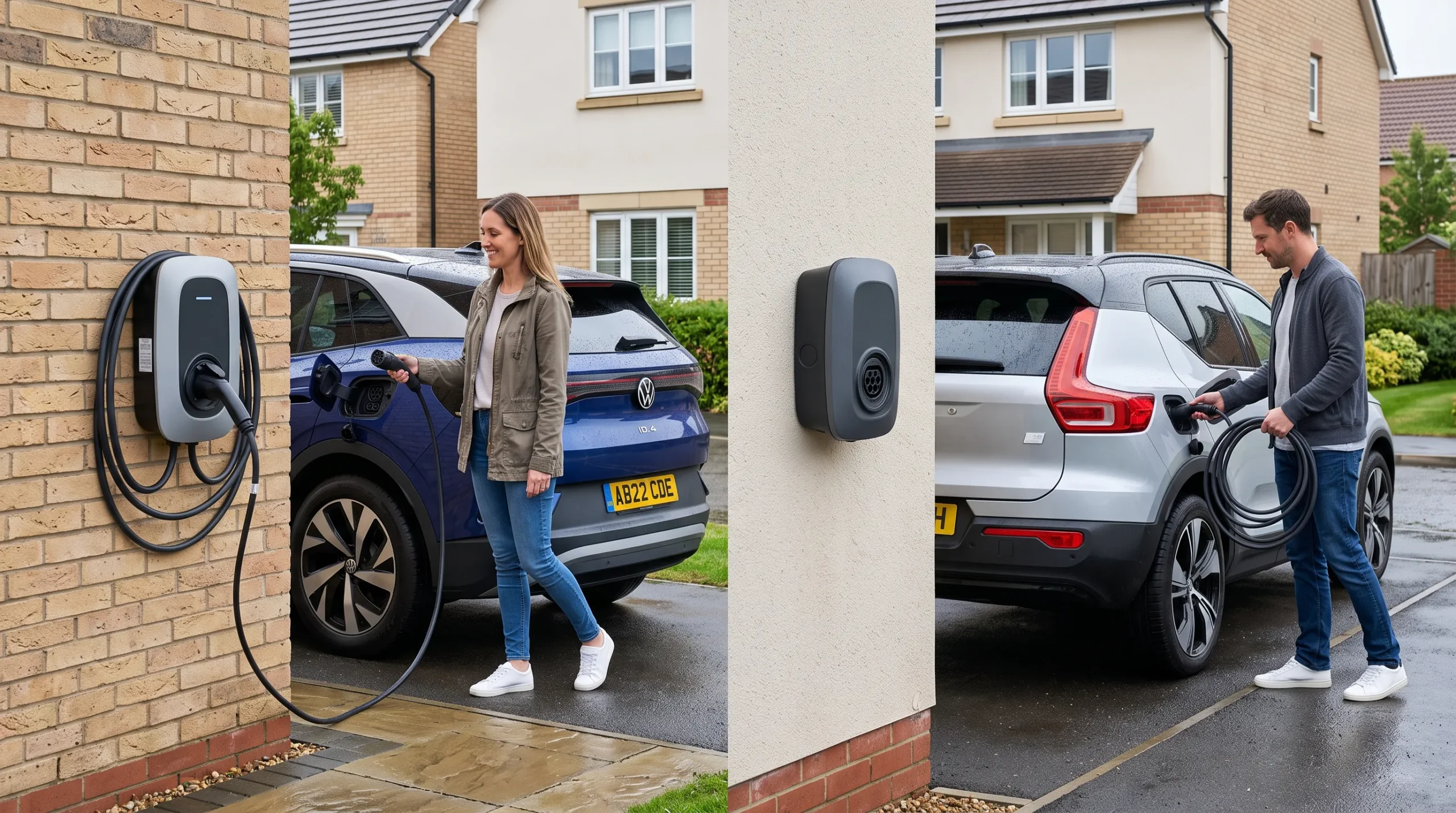
A tethered EV charger has the charging cable fixed to the unit, like a petrol pump. An untethered charger is a socket on the wall, and you plug in your own Type 2 cable. Both charge at exactly the same speed, because speed comes from the charger’s power (7kW is the limit on a normal UK single phase supply) and from what your car’s onboard charger will accept, not from the cable setup. So the choice is about daily habits, looks, cost and flexibility. For a household with one EV and a driveway, a tethered charger is usually the better pick. For two different cars, an older car with a different connector, or a wall where you want the cleanest look, untethered usually wins.
If you want the quick version, use this. Pick tethered if you charge the same car at the same spot most nights and want to plug in without thinking. Pick untethered if more than one car will use it, you might change cars soon, or you care more about how the wall looks than about saving ten seconds each evening.
The table below puts the main points side by side. The sections after it go through each one.
Tethered and ready to fit: VOLEC Pulse 7kW, Type 2, tethered 5m or 10m cable, load management, solar aware, IP66, 10 year warranty. £279 with installation arranged at checkout. See the VOLEC Pulse
| Question | Tethered | Untethered |
| Cable | Fixed to the charger | Your own Type 2 cable |
| Charging speed | Same | Same |
| Daily use | Grab it and plug in | Fetch the cable, plug in at both ends |
| Looks | Cable always on show | Clean wall unit, cable stored away |
| Cost | Unit costs a little more | Unit costs less, but you need a cable |
| Older or different cars | Type 2 cars only | Works with Type 1 cars through the right cable |
| Two cars | Fine if both are Type 2 and the cable reaches | Easier, each car uses its own cable |
| Public charging | Needs a separate portable cable | Use the same cable you leave at home |
| Cable damage | Repair or swap affects the charger | Replace the cable only |
“Is there any difference in charging speed?”
No. This is the most common worry, and the answer is a flat no.
A 7kW charger delivers up to 7.4kW on a 32A circuit whichever way the cable is arranged. Your car then takes what its own onboard charger allows. Plenty of EVs stop at 7kW, some older or smaller ones at 3.7kW or 6.6kW. A tethered cable doesn’t speed anything up, and an untethered socket doesn’t slow anything down.
What can slow you down is the cable itself, if it’s the wrong type for the job. A good Type 2 cable rated for 32A matches a 7kW charger. A thin or damaged one may not. That applies to untethered setups, because you’re supplying the cable. With a tethered unit the manufacturer has already matched the two.
“Which one is easier to live with every day?”
Tethered, by a clear margin, if you use it daily.
Think about a wet evening in January at 6pm. With a tethered charger you lift the cable off its holder, push it into the car, and go inside. With an untethered one you open the boot, find the cable, plug one end into the wall, the other into the car, then coil it back up the next morning. Ten or fifteen seconds extra, twice a day. Nobody notices it in July. Everybody notices it in January.
A common workaround is to leave the untethered cable plugged into the wall all the time, and in that case it behaves almost like a tethered unit. Lots of owners do exactly that. It’s worth knowing, though, that it leaves a loose cable hanging outside, which brings up the theft and wear questions further down.
“Which is cheaper, tethered or untethered?”
Untethered units usually cost a little less on the shelf. Once you add a decent Type 2 cable, the saving mostly disappears.
If you already own a cable that came with your car, and it’s rated for the charge rate you want, the untethered route can work out cheaper. If you need to buy one, the gap shrinks fast. Installation costs are the same for both, since the electrical work is identical: a dedicated circuit from your consumer unit, protection devices and testing.
So don’t let a small difference in unit price decide it. Choose on how you’ll use it. The unit price is a small part of what you’ll spend over ten years of charging.
“Is a tethered charger safer from theft?”
For the cable, yes. It’s fixed to the charger, so nobody can unplug it and walk off with it.
An untethered cable that’s left connected to the wall socket can be pulled out. Some units have a locking socket or pin protection that stops this, and it’s worth asking about if you go untethered and leave the cable outside. Cables aren’t cheap, so it’s a real risk on a driveway visible from the street.
A tethered cable can still be cut or damaged by a determined person. Fixing it to the unit removes the easy theft, not every possible one. If your driveway is exposed, a camera or good lighting does more than the cable type does.
“What if I have two EVs, or I change cars?”
Untethered is the more flexible choice here, though tethered copes with more than people expect.
Any current car with a Type 2 port can use a tethered Type 2 charger. So if you swap one modern EV for another, nothing changes. The trouble comes with a second car whose charge port sits on the opposite side or at the other end of the vehicle. A tethered cable that reaches one car comfortably may stretch for the other. A longer cable fixes most of that, and the Pulse is available with 5m or 10m tethered.
With an untethered charger, each car can use its own cable, which helps when two drivers share one wall box and each keeps a cable in their boot. It also helps if you expect to move to a different kind of car in a few years.
“What about older or imported cars with a different connector?”
Most modern UK electric cars use Type 2 for AC charging. Some older models and imports use Type 1 instead.
A tethered charger is almost always Type 2, so it won’t plug straight into a Type 1 car. An untethered Type 2 socket works with a Type 1 to Type 2 cable, and that makes untethered the easy answer if your car has a Type 1 port. Check your car’s charge port, and the cable supplied with it, before you order anything.
“Do I need a separate cable for public chargers?”
If you go tethered, yes, probably.
Most public AC charge points in the UK are untethered, which means you bring your own cable. A tethered home charger doesn’t give you one, because its cable is stuck to the wall. Many cars come with a cable in the boot, but not all, so check what yours came with. If you drive long distances or rely on destination chargers, you’ll want one anyway.
With an untethered home setup, you can take your home cable with you, though then your home charger has no cable until you’re back. Buying a second cable solves that.
“What happens when the cable wears out or gets damaged?”
This is where untethered has a real advantage. If the cable is damaged, you buy a new one and plug it in. The charger on the wall isn’t affected.
On a tethered unit, a damaged cable means a repair or a replacement on the charger itself, often by the installer or manufacturer. Some tethered units are built so the cable can be swapped. Ask before you buy. A long warranty that covers parts and labour makes this much less of a worry, and the Pulse carries ten years covering parts, labour and the electrical connection. Read the exclusions on any warranty, because cable damage from accidents often sits outside normal cover.
Care helps either way. Keep the cable off the ground when it isn’t in use, don’t let the car drive over it, and coil it loosely on the holder. A 7kW cable is heavy, and one left lying in water or on the road wears out faster than one kept off the ground.
Not sure which type suits your parking spot? Send us a photo of the wall and your car’s charge port. VOLEC includes a free panel check before installation. Start your free panel check
Choosing the cable length on a tethered charger
If you go tethered, the cable length matters more than it did for untethered, because you can’t swap it later without work.
Measure from the charger to the charge port with the car parked where it actually sits, and add a metre. A 5m cable suits a driveway where you park close to the wall. A 10m cable suits a long drive, a charger on the side of the house, or a household that parks nose in one day and reversed the next. If you’re unsure, go longer. The extra length coils on the holder, while a short cable is a problem you can’t fix without replacing it.
The full guide to choosing between the two is in our best home EV charger buyer’s guide.
Weather and the outdoor question
Both types sit outside, so the charger’s weather rating matters more than the cable type. Look for IP65 at a minimum and IP66 if you want a margin of safety. IP66 means the casing is sealed against dust and can take powerful water jets.
An untethered unit has an open socket, so check how well the socket is protected when the cable is out, and keep it fully seated when in use. A tethered unit has no open socket to worry about. The Pulse is IP66 and tested from minus 30 to 50 degrees Celsius, so it needs no cover or carport.
Smart features and everything else are the same
None of the smart features depend on the cable. Scheduling, app control, load management, solar aware charging and over the air updates all work the same way on both types. Load management reads your home’s current and lowers the charger’s output when other appliances switch on, so it protects your main fuse either way. Solar aware charging shifts charging to use surplus power from your panels either way.
Home chargers sold in Great Britain also have to meet the Smart Charge Point Regulations, in full since 30 December 2022, whichever type you buy. So the decision stays about the cable, and the rest is covered by what the charger itself offers. For the tariff and cost side, the buyer’s guide goes through night rates and what a year of charging costs.
Where the VOLEC Pulse fits
The VOLEC Pulse is a tethered 7kW smart home charger at £279, with installation arranged at checkout. It comes with a 5m or 10m cable, adaptive load management, solar aware charging, an IP66 casing, app scheduling over Wi-Fi, over the air updates and a ten year warranty.
It’s built for the household described at the top: one or two EVs, a driveway or garage wall, and a daily habit of plugging in at the same spot. If you need an untethered unit for a Type 1 car, or you want a bare socket for a shared wall box, check the options on the shop page or ask us first through the contact page.
Three mistakes to avoid
Choosing untethered to save money, then paying for a cable that cancels the saving.
Choosing tethered with a cable that’s too short for the car’s charge port.
Forgetting that a tethered charger won’t charge you away from home without a separate cable.
Which one should you pick?
Go tethered if you have one EV, a fixed parking spot and a Type 2 port, and you want charging to take no thought at all.
Go untethered if you have a Type 1 car, two cars with different needs, a plan to change vehicle soon, or a wall where looks matter most.
If you’re still split, think about January. The option you’d rather deal with on a cold wet evening is usually the right one.
Frequently asked questions
What is the difference between a tethered and an untethered EV charger?
A tethered charger has the charging cable permanently attached to the unit. An untethered charger has a Type 2 socket, and you plug in your own cable. They charge at the same speed.
Is a tethered or untethered EV charger better for a UK home?
Tethered is better for one car and daily convenience, because the cable is always ready. Untethered is better if you have two cars, an older car with a Type 1 port, or want a cleaner look on the wall.
Does a tethered EV charger charge faster than an untethered one?
No. Charging speed depends on the charger’s power output, your car’s onboard charger and your home’s electricity supply, not on whether the cable is fixed or removable.
Are tethered EV chargers more expensive?
The unit usually costs a little more than an untethered one, but you need to buy a cable for an untethered unit, so the final difference is small. Installation costs are the same for both.
Can I use an untethered EV charger with an older Type 1 car?
Yes, with a Type 1 to Type 2 cable. A tethered charger is almost always Type 2, so it won’t plug into a Type 1 car directly.
Do I need a separate cable for public chargers if I have a tethered home charger?
Usually yes. Most public AC charge points in the UK are untethered, so you bring your own cable. A tethered home charger’s cable is fixed to the wall, so carry a portable one.

Pingback: Smart vs Standard EV Charger UK: What Is the Difference?
Pingback: Best EV Charger for Solar and Home Battery in the UK