
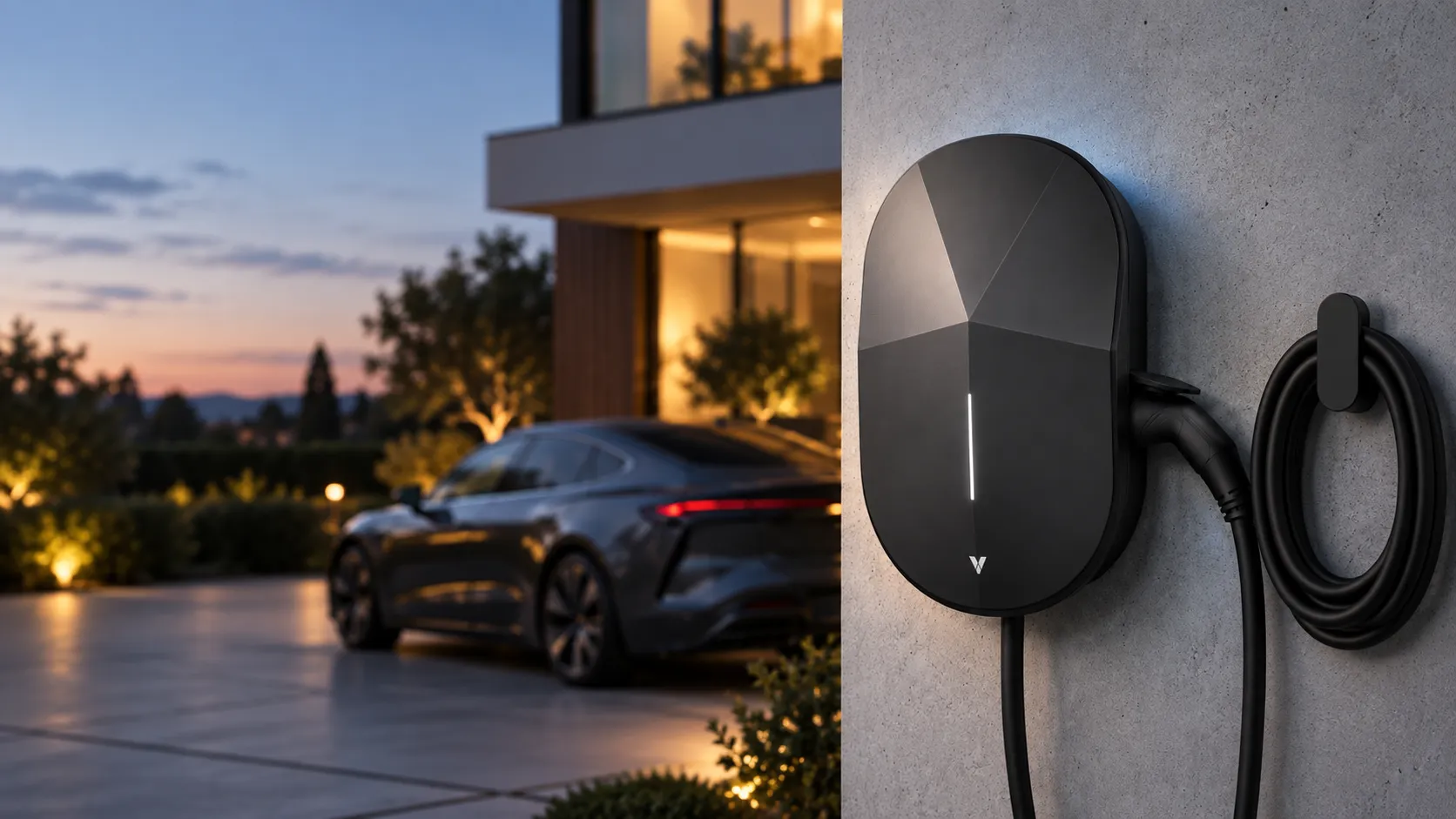
For most UK homes, the best home EV charger in 2026 is a 7kW Type 2 wallbox with a tethered cable, load management and an IP65 or IP66 rating, fitted by a qualified electrician on its own circuit. On a normal single phase supply, 7kW means up to 7.4kW from a 32A circuit, which puts roughly 20 to 30 miles of range into the car every hour. A night on that charger refills nearly any EV. Run it on a night tariff at around 7 to 9p per kWh instead of the standard 26p or so (the Ofgem cap is 26.32p per kWh from 1 October 2026) and the charger earns its cost back in cheaper miles.
Since 30 December 2022, every home charger sold in Great Britain has had to meet the Smart Charge Point Regulations. Those cover smart functions, default off-peak charging hours, a short random delay when a session starts, and basic security. Nearly every new unit ticks the “smart” box, so that word tells you very little. The features below are what actually set one charger apart from another.
Best overall pick: VOLEC Pulse 7kW, Type 2, load management, solar-aware, IP66, 10-year warranty. £279 with installation arranged at checkout. See the VOLEC Pulse
The table sums up what to look for in the best home EV charger UK households can buy this year. Each row gets more detail further down.
| Feature | Best choice | Why it matters |
|---|---|---|
| Power | 7kW (7.4kW maximum on single phase) | Fills most EVs overnight, and anything faster needs a three phase supply |
| Connector | Type 2 | Standard on modern UK electric cars |
| Cable | Tethered, 5m or 10m | Always ready to use, with nothing to carry or store |
| Supply handling | Load management | Protects your main fuse when other appliances are running |
| Solar | Solar aware charging | Puts surplus power from your panels into the car |
| Weather rating | IP65 or IP66 | Safe to mount outdoors all year |
| Smart features | Scheduling, app control, over the air updates | Lets you use cheap night rates and keeps the unit up to date |
| Warranty | 10 years covering parts and labour | A charger sits outside for a decade or more |
| Installation | Booked with a qualified electrician | A dedicated circuit that is tested and signed off |
“Is 7kW fast enough?”
Yes, for almost everyone.
Say your car manages about 3.5 miles per kWh and you drive 30 miles on a normal day. That’s under 9kWh, so a 7kW charger replaces it in about an hour and a quarter. Even if you roll in near empty with a big battery, a night of six to eight hours covers it.
Faster home chargers only exist for three phase supplies, and most houses don’t have one. So there’s nothing quicker to hold out for.
A three pin socket with a granny cable sits at about 2.3kW at best, which is 6 to 8 miles an hour. Fine for an emergency top up. Not something to rely on for months, because a household socket isn’t built to run near its limit for hours every night.
Your car has a limit of its own too. Its onboard charger decides how much AC power it accepts, and plenty of models stop at 7kW. Some older or smaller ones stop at 3.7kW or 6.6kW. Pay extra for a faster unit than the car can take and you get nothing for it.
Tethered or untethered?
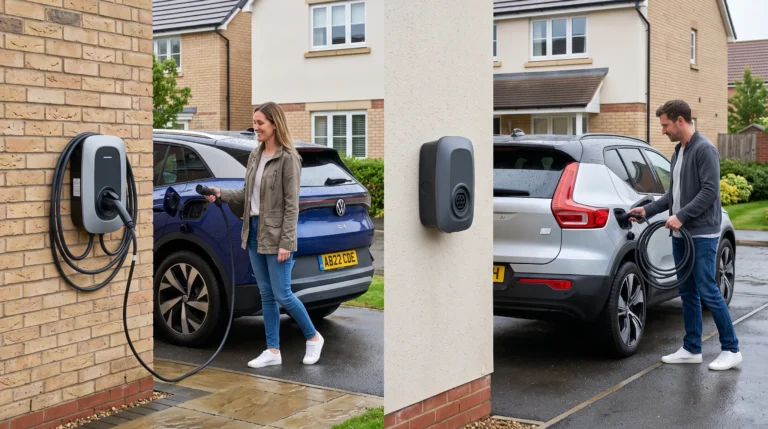
A tethered charger has the cable fixed to the unit, like a petrol pump. An untethered one is just a Type 2 socket, and you bring your own cable.
Most one car households are happier with tethered. You lift the cable off its holder, plug in, and go inside. When it’s raining or dark at 6pm in January, that counts for more than it sounds. The cable can’t be taken either, since it’s attached. If you have a driveway and one regular car, a tethered unit is usually the best EV charger for UK driveways.
Untethered looks tidier on the wall. It also makes more sense if you swap cars every few years, or two drivers with different vehicles share the unit. And if you already own a good cable, you’ve got no reason to buy another.
Both charge at identical speed. The cable type changes how you use it and nothing else.
Choosing the cable length
Measure from the charger to the charge port with the car parked where it really sits, then add a metre.
Ports are not all in the same place. Front corner, rear corner, driver’s side, passenger side. A 5m cable works if you park close to the wall and the port is near the charger. A 10m cable suits a long drive, a charger on the side of the house, or a household that parks nose in one day and reversed the next.
Too short is a pain you can’t fix without replacing the cable. Too long just means a coil to hang on the holder. If you’re torn, go longer. The Pulse comes tethered in 5m and 10m versions on the shop page.
“What smart features are worth paying attention to?”
Legally, smart is the minimum now. So check what the smart part does.
Scheduling comes first. You pick a window, 11:30pm to 5:30am for example, and the charger holds off until then. It’s how you get a cheap night rate without remembering to plug in at midnight.
Then the app. You want to start and stop sessions, change the charging current, and see how many kWh each session used. A plain on and off switch gives you nothing to check your bill against.
Over the air updates get ignored in most buying guides, and they shouldn’t be. Tariffs shift, standards shift, firmware has bugs. A charger that updates itself is still current in year eight. One that needs an installer visit usually isn’t.
Last, Wi-Fi. Walk to where the charger will hang and check your phone gets a signal there. Plenty of driveways sit at the far edge of the router’s range.
“Will my fuse box cope with a charger?”
Most buyers never think to ask this, and it’s the one that causes trouble later.
A 7kW charger pulls about 32 amps. Put that next to an electric shower, an oven and an immersion heater on a busy evening and you can get close to the limit of the supply coming into the house. The main fuse doesn’t give second chances.
Load management deals with it. The charger watches the total current going through your home, drops its own output when something else switches on, and picks it back up when that stops. You stay inside the limit and still charge as quickly as the spare capacity allows. Without it, an installer often has to set the charger to a low, fixed speed to be safe.
Older houses and smaller supplies gain the most. Ask whoever quotes what they will check first. VOLEC includes a free panel check with every order, which confirms what your home can run safely before the install gets booked. There’s more on the installation page.
Not sure if your home supply can handle a 7kW charger? VOLEC includes a free panel check before installation. Start your free panel check
Solar panels
If you have panels, or you’re planning them, look for a charger that reads your solar output.
A solar aware unit spots surplus, the power your panels make that the house isn’t using, and shifts charging to soak it up. Normally that surplus goes back to the grid for a small export payment. In the car, it’s worth more.
Setups differ. Some chargers need a sensor clamp on the supply cable. Some only work with particular inverters. Ask whether it can run on surplus alone, or in a mixed mode that tops up from the grid when it’s cloudy, and confirm what your own system needs before you order.
“Can it go outside?”
Yes, with a proper IP rating. IP65 is the lowest worth considering and IP66 gives more margin.
IP66 means sealed against dust and rated for powerful water jets, so driving rain and a pressure washer on the wall are covered. Look at the temperature range as well, since frost is hard on plastics and electronics. The Pulse is IP66 and tested from minus 30 to 50 degrees Celsius, so it needs no cover and no carport.
Where the real saving comes from
The charger doesn’t make charging cheap. The tariff does.
At the Ofgem cap you pay about 26p per kWh. On Intelligent Octopus Go the off-peak rate is around 7.6p between 11:30pm and 5:30am, and the car gets up to six hours of smart charging at that price each day. Whole home electricity drops to the cheap rate in that window too. British Gas EV Power is around 9p per kWh from midnight to 5am, with a slightly cheaper EV Power Plus version for those who qualify. These move often, so check the supplier’s own page before switching.
Take a car doing 8,000 miles a year at 3.5 miles per kWh. That’s roughly 2,300 kWh. At 7.6p it comes to about £175. At 26p it’s about £600. Over ten years, the gap pays for the charger several times.
One check before you order. Some tariffs control charging through the charger itself, and each supplier keeps a list of approved units. If a specific tariff matters to you, ask us or the supplier whether the model you want is on it.
“Is there a government grant?”
Probably not if you own a house with a driveway.
The OZEV chargepoint grant is up to £500 per socket from 1 April 2026, up from £350, and the scheme runs to 31 March 2027. It targets renters, flat owners and landlords. You also need off-street parking and an eligible EV, and an OZEV approved installer applies the grant to your invoice.
Confirm you qualify before you book the install, because the installer handles the claim and the rules are strict about order. Check GOV.UK for the latest wording too, since eligibility can change.
“What does installation involve, and what does it cost?”
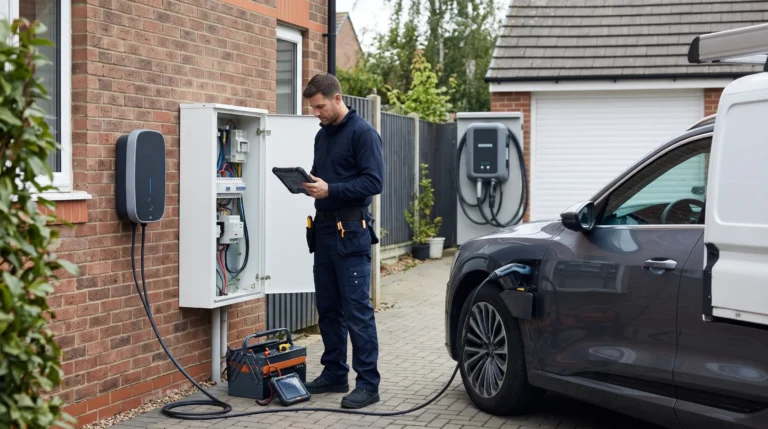
Home EV charger installation in the UK covers mounting the unit, running a dedicated circuit from your consumer unit, fitting the right protection devices and testing the lot. Most jobs take two to four hours on site.
Prices for a charger and fit are often quoted between about £800 and £1,500. The cable run from your fuse box makes the biggest difference, along with whether the consumer unit needs replacing. A long route through walls or across a drive costs more than a short one on a garage wall.
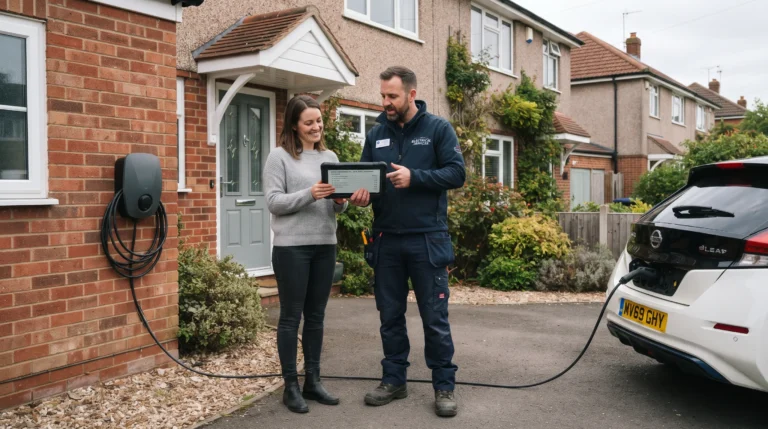
Whoever does the work should be registered to sign off electrical jobs, and you should get the paperwork afterwards. With the Pulse, a licensed electrician is booked at checkout, and anything unusual, like a difficult cable route, is flagged and agreed before the day. The full list of questions is on the FAQ page.
Warranty
Two or three years is common, and often only for parts. The Pulse carries ten years covering parts, labour and the electrical connection. Whatever you buy, read the exclusions and check whether the cover passes to the next owner if you move.
Where the VOLEC Pulse fits
The VOLEC Pulse is a 7kW smart home charger at £279, with installation arranged at checkout. It has adaptive load management, solar aware charging, an IP66 casing, app scheduling over Wi-Fi, over the air updates and the ten year warranty. It suits homes with one or two EVs, a driveway or a garage wall, and a fuse box nobody has looked at for years.
It isn’t the one for you if you want a three phase 22kW unit. And if your supply is tight, do the free panel check first, because it tells you what the house can run before you’ve paid for anything. Questions about your own setup can go through the contact page.
Three mistakes people make
Choosing on price alone. A cheaper charger without load management or an outdoor rating often costs more once you’ve added what’s missing.
Skipping the supply check, then finding out the house can’t take it, and waiting for a new quote.
Guessing the cable length. Measure it.
Frequently asked questions
Everything buyers ask about home EV chargers in the UK: speed, installation, costs, grants, solar and warranty.
Choosing a charger
What is the best home EV charger in the UK?
A 7kW Type 2 wallbox with load management, an IP65 or IP66 rating and professional installation suits most UK homes. The VOLEC Pulse has all four at £279, with installation arranged at checkout.
Is a 7kW home EV charger enough?
Yes, for almost every household. 7kW refills most EVs overnight, and anything faster needs a three phase supply that most houses don’t have.
Should I buy a tethered or untethered EV charger?
Tethered suits one car and daily ease, because the cable is always ready. Untethered gives a tidier wall and more flexibility if you change cars. Both charge at the same speed.
What cable length do I need, 5m or 10m?
Measure from the charger to the charge port with the car parked where it really sits, then add a metre. A 5m cable works when you park close to the wall. A 10m cable suits long driveways and chargers on the side of the house.
What is a Type 2 connector?
Type 2 is the standard AC charging connector on modern UK electric cars and plug in hybrids. Some older imported models use a different connector, so check your car’s charge port before you order.
Will a home charger work with any electric car?
Any EV with a Type 2 port can charge from a Type 2 charger. How fast it charges is set by the car’s own onboard charger, not by the wallbox.
Do I need a smart EV charger?
Yes. Home chargers sold in Great Britain must meet the Smart Charge Point Regulations, in full since 30 December 2022. They cover smart functions, default off-peak charging hours, a random start delay and security.
What is the difference between a smart charger and a standard charger?
A smart charger connects to an app or the internet, so you can schedule sessions, change the charging current and see how much energy each session used. A basic charger just supplies power when you plug in.
Charging speed
How fast does a 7kW EV charger charge?
Roughly 20 to 30 miles of range per hour, depending on how efficient your car is.
How long does it take to charge an EV at home?
A 60kWh battery going from 20 to 80 percent needs about 36kWh. At 7kW that takes around five to six hours once you allow for charging losses. Smaller top ups take much less.
Can I charge faster than 7kW at home?
Only on a three phase supply, where 11kW and 22kW units exist. Most UK houses have single phase, where 7.4kW is the ceiling.
Is it safe to charge an EV overnight?
Yes. Home chargers and modern EVs are built for it, and the car manages the session and stops when the battery is full. The charger should be on its own circuit, installed and tested by a qualified electrician.
Can I use a normal three pin socket instead of a charger?
In an emergency, yes, but it is slow at around 6 to 8 miles of range per hour. A household socket isn’t designed to run near its limit for hours every night, so a dedicated charger is the safer choice.
Installation
How long does home EV charger installation take in the UK?
Usually two to four hours on site, though the exact time depends on your property and the electrical work needed.
What does a standard EV charger installation include?
Mounting the charger, installing a dedicated circuit from your consumer unit and connecting it to your home’s supply, then testing everything. The exact scope depends on your property and the installation assessment.
Where can my EV charger be installed?
On a suitable internal or external wall close to where the car normally parks. The final position depends on the electrical supply, the cable route and the parking arrangement.
Can the charger be installed on my driveway?
Potentially. It needs a suitable mounting surface, and the cable has to reach the car without creating a trip or vehicle hazard.
What is the free panel check?
It is a load capacity check of your electrical panel that confirms what your home can safely run before the install is booked. You answer a few questions about your panel or send a photo of it. Start your free panel check.
What if my fuse box or supply is too small for a 7kW charger?
Load management lets the charger lower its output when other appliances are running, so it stays inside your supply limit. If extra electrical work is needed, it should be identified and agreed before installation.
Do I need planning permission for an EV charger?
In many cases no, but the rules vary for flats, listed buildings, conservation areas and homes in Scotland, Wales and Northern Ireland. Check with your local council before you order.
Can I install an EV charger in a rented home or flat?
You will need permission from your landlord or freeholder first, and you need access to off-street parking. Renters and flat owners are also the main groups the OZEV grant is aimed at.
Can I fit an EV charger myself?
No. A charger needs a dedicated circuit, protection devices and testing, so it should be fitted by a qualified electrician who signs off the work and gives you the paperwork.
Cost and grants
How much does a home EV charger cost in the UK?
The VOLEC Pulse is £279 with installation arranged at checkout. Elsewhere, a charger and fit are often quoted at roughly £800 to £1,500, mostly depending on the cable run and whether the consumer unit needs replacing.
Is installation included with the VOLEC Pulse?
Yes. VOLEC states that installation with a licensed electrician is included and scheduled at checkout, together with the panel check.
Are there any extra installation costs?
Standard installation is included where the property meets the standard requirements. Additional electrical work or a non standard cable run may cost extra, and it should be identified and agreed before the install.
How much does it cost to charge an EV at home?
About 7 to 9p per kWh on a night EV tariff, against about 26p at the Ofgem price cap from 1 October 2026. For 8,000 miles a year that works out to roughly £175 against £600.
What is the cheapest way to charge an EV at home?
Use an EV tariff with a cheap night window, such as Intelligent Octopus Go at around 7.6p per kWh between 11:30pm and 5:30am, and schedule your charger to run inside it. Rates change often, so check the supplier’s page.
Can I get a government grant for a home EV charger?
The OZEV grant is up to £500 per socket until 31 March 2027, but it mainly covers renters, flat owners and landlords, not homeowners with a driveway. Check GOV.UK for the latest rules.
Do I need an OZEV approved installer to claim the grant?
Yes. The approved installer applies the grant to your invoice, so confirm you qualify before the install is booked.
Smart features, solar and weather
What is load management on an EV charger?
The charger reads your home’s total current in real time and lowers its own output when other appliances switch on, then raises it again when they stop. It keeps you inside your supply limit without a fixed low speed.
Can I use a home EV charger with solar panels?
Yes, if the charger is solar aware. It detects surplus power from your panels and shifts charging to use it. Confirm what your own solar system needs before you order, because some setups need a sensor or work only with certain inverters.
What is solar aware charging?
It means the charger spots power your panels make that the house isn’t using and puts it into the car, instead of sending it back to the grid for a small export payment.
Can I schedule charging from my phone?
Yes. The VOLEC app lets you set a charging schedule around off-peak rates, and the charger connects over Wi-Fi.
Can the charging power be changed after installation?
VOLEC states that the charging current can be adjusted through the app, with the safe maximum set during installation. It should only be configured within the limits set at installation.
Does an outdoor EV charger work in rain and frost?
Yes, if it has a proper rating. The VOLEC Pulse is IP66 and tested from minus 30 to 50 degrees Celsius, so it needs no cover or carport.
What does IP66 mean on an EV charger?
The casing is sealed against dust and rated to handle powerful water jets, which covers driving rain. IP65 is the lowest rating worth considering for outdoor use.
Does the VOLEC Pulse get software updates?
Yes. It receives over the air updates for scheduling logic, rate plan support and firmware fixes, so there is nothing to reinstall.
Warranty and support
How long is the VOLEC Pulse warranty?
Ten years, covering parts, labour and the electrical connection.
Is the warranty transferable if I move house?
That depends on the warranty terms. Check the current warranty documents or contact VOLEC before assuming cover passes to a new owner.
What should I do if my charger develops a fault?
First check that the charger has power and the car is connected properly. If the problem continues, contact VOLEC with your order details and any error message from the charger or app. Contact VOLEC.
Can I cancel or return my order?
Cancellations and returns follow VOLEC’s current refund and return terms on the Refund and Returns page. Contact support as soon as you can if you need to cancel.
How do I contact VOLEC?
Use the contact page for questions about orders, installation, compatibility or technical support. The team replies within one working day.
Still have a question?
VOLEC includes a free panel check before installation, so you know what your home can run before you pay.

Pingback: EV Charger Load Management UK: What It Is | VOLEC