For almost every UK home, the answer is 7kW. A 22kW charger needs a three phase electricity supply, and most houses in the UK only have a single phase. Even when a house does have three phases, the car has to be able to take 22kW, and most can’t. A 7kW charger fills nearly any electric car overnight, and it costs far less to fit.
A 22kW charger only makes sense in a few cases: a home that already has three phase power, a car that accepts 22kW from an AC charger, and a real need for the speed. If one of those is missing, you’d be paying extra for a charger your house or your car can’t use.
Below we go through the difference in plain terms, why the supply and the car matter more than the charger itself, how long each one takes, what the extra speed costs, and how to work out which one suits you.
“What’s the difference between a 7kW and a 22kW charger?”
Power. A 7kW charger sends up to about 7.4kW to your car, which is what you get from a 32 amp circuit on a normal single phase supply. A 22kW charger sends up to about 22kW, which is three of those circuits working together on a three phase supply.
So the number jumps by three. Three phase power is basically three separate live supplies coming into a building, each carrying 32 amps to the charger. A single phase house has only one.
The speed difference is real on paper. A 7kW charger adds roughly 20 to 27 miles of range every hour. A 22kW charger can add up to 75 miles or more an hour, if the car can accept it. We’ll come back to that “if”, because it’s where most people go wrong.
“Can your house even have a 22kW charger?”
Probably not, and this is the biggest reason people end up choosing 7kW.
Nearly all UK houses and flats have a single phase supply. A 22kW charger needs three phase, so unless your home was built with it, or it’s a larger property that has had it added, the faster charger just isn’t an option.
If your home has single phase and you still want 22kW, the supply has to be upgraded. That means applying to your network operator, who owns the cable in the street, and having work done to bring three phase to your property. It’s often several thousand pounds, sometimes a lot more, and it can take weeks or months to arrange. For most families the money does more good somewhere else.
So before you look at chargers at all, find out what supply you have. We explain how further down.
“Does your car matter more than the charger?”
Yes, and it matters more than most buyers expect.
Home charging uses AC power. Your car has a built in unit, called an onboard charger, that turns it into the DC power the battery needs. That unit has a ceiling. You get the lower of two numbers: what the wallbox can supply and what the car will accept.
Plenty of cars accept 7.4kW at home. Some smaller or older ones stop at 6.6kW or even 3.7kW. A good number of newer cars accept 11kW, but only on three phase. Only a small group can take 22kW on AC, and the list is mostly older or premium models, such as the Renault Zoe, the BMW i3 and the Tesla Model S and Model X, depending on the version. A Tesla Model 3, for one, tops out at 11kW.
So a car that accepts 7.4kW charges at 7.4kW on a 7kW charger and on a 22kW charger. The bigger unit adds nothing. Look up your car’s maximum AC charging rate in the manual or the maker’s UK specification sheet, and check the exact trim, because it can differ between versions of the same model.
“How many miles per hour does each charger add?”
On a 7kW charger, expect about 20 to 27 miles per hour. A thrifty car lands near the top of that, and a big heavy SUV near the bottom. Some of the power is lost as heat, which is why you never quite get the headline figure into the battery.
On a 22kW charger, a car that can accept it might add somewhere around 75 miles an hour in good conditions. A car that can only accept 11kW gets about half that, and a car limited to 7.4kW gets the same 20 to 27 miles as it would from a 7kW unit.
Think about what you drive in a normal day. Most UK drivers cover around 20 to 25 miles a day, and a good many do less. A 7kW charger puts that back in an hour or so. A 22kW charger would do it in twenty minutes, but you weren’t going to be standing next to the car anyway.
“Will a 7kW charger fill your car overnight?”
For nearly every car, yes.
Say you plug in at 10pm and unplug at 7am. That’s nine hours. At 7.4kW, after losses, you put roughly 50kWh or more into the battery, which is a full day’s driving many times over, and enough to take a mid sized battery from low to full. Cheap night tariffs often run for around five or six hours, and even a window that short adds well over a hundred miles at 7kW.
Where it gets tight is a very large battery that you regularly run right down, or a car that only accepts 3.7kW. In those cases an overnight charge might not go from empty to full. But a faster home charger wouldn’t fix the second one, because the car is the limit. If you want the full picture on whether a 7kW home EV charger is enough, that page goes through it step by step.
What does a 22kW charger cost?
The charger itself usually costs a little more than a 7kW unit. The installation costs a lot more.
A 22kW install means thicker cable, bigger protective equipment, a three phase connection and often more work at the consumer unit. The bill depends on how far the charger is from the fuse board and how much of the supply needs changing. If your home needs a three phase upgrade from the network operator on top, that can add several thousand pounds.
A 7kW install on a normal single phase supply is much simpler. It’s usually a short job. If you want to see what moves the price up or down, the EV charger installation cost in the UK breakdown covers it.
“What about 11kW?”
It sits in the middle, and it only works on three phase.
An 11kW charger is a slice of power on each of three phases, at 16 amps each. That’s roughly a third quicker than 7kW. Plenty of newer cars accept 11kW, so if your home already has three phase and your car can take it, 11kW is often a better fit than 22kW, because it gets most of the benefit with simpler equipment.
On a single phase home, though, an 11kW charger isn’t an option. It would deliver only what the single phase supply allows, which is 7.4kW. So 7kW is the standard choice for the great majority of houses.
“When does 22kW make sense?”
In a few specific situations.
The first is a home or business that already has three phase power, with a car that accepts 22kW. Then the faster speed is real, and the extra cost is smaller because the supply is already there.
The second is several cars sharing one supply. A household with two or three EVs that all need topping up quickly in the evening can use the extra capacity, especially with load management sharing it out.
The third is high mileage. Someone covering 200 miles a day, such as a taxi driver, needs a lot of energy back in a short window. A 7kW charger would need around nine hours to replace that, which leaves no room. A faster charger, plus rapid charging on the road, takes the pressure off.
The fourth is a workplace or fleet. Vehicles that come back in and need to be out again within a few hours are the classic case for 22kW.
Outside those, it’s usually money spent for a speed you can’t use.
“Can you put a 22kW charger on a single phase supply?”
You can fit one, but it won’t charge any faster than a 7kW unit.
A single phase supply can only deliver about 7.4kW, whatever the label on the charger says. A 22kW charger on single phase simply runs at the single phase limit. So you’d pay more for the unit and get exactly the same speed as the cheaper charger.
Some 22kW chargers are also designed to be set to a lower limit, which an installer can do if your supply is tight. That helps if you want to keep the option open, but it doesn’t change the point: unless the supply is three phase, the extra power never reaches the car.
“What if you change the car later?”
This is the argument people make for buying a bigger charger: what if the next car is faster?
It’s a fair worry, but the numbers rarely support it. A new car that accepts 11kW or 22kW still charges at 7.4kW on a single phase supply, so it doesn’t strand you. It just charges at the limit your house allows, and overnight that’s usually plenty.
If you’re planning to move to a house with three phase, or you’re already upgrading your supply for another reason, then thinking ahead makes sense. Otherwise, a 7kW charger on the supply you have today covers almost every car you’re likely to drive for years.
“Is a faster charger more expensive to run?”
No. Cost per kWh depends on your tariff, not on the charger. You pay for the electricity that goes into the car, so the same amount of charge costs the same on a 7kW unit as on a 22kW unit.
What changes the bill is when you charge. A night rate on an EV tariff is often a fraction of the standard daytime price, around 7 to 9p per kWh on many plans, against the mid twenties on a standard tariff. A smart charger that schedules around the cheap window saves you more than any extra power would.
Smart features matter more than raw speed for most people. The difference between a smart EV charger and a standard charger comes down to scheduling and an app, and that’s where the savings are.
“Will a faster charger overload your fuse box?”
It can, if the supply can’t cope with it. A 22kW charger pulls a large current, and a house with a modest main fuse and plenty of other appliances can struggle to run it alongside a shower, an oven and a heat pump.
A 7kW charger draws around 32 amps. On most single phase homes with a 60 to 100 amp supply that’s manageable, but it’s still a big load. Load management is the feature that makes it safe. It watches the supply and eases the charger’s output down when other things are running, so the main fuse isn’t pushed past its limit. We explain how it works in EV charger load management.
With a 22kW charger, load management matters even more. It’s what stops the whole system tripping when everything runs at once.
“Does solar change the answer?”
No. If anything, it makes the case for a smaller charger stronger.
Solar panels rarely produce 7kW of surplus, let alone 22kW. On a good sunny day a typical domestic array might give you a few kilowatts spare. A charger that follows your solar output will charge at that slower speed, and a 22kW unit can’t charge any faster than the sunshine allows.
So the speed you want from the grid is a separate question from the speed you’ll get on solar. You can read how solar aware charging works in more detail, and if you have a home battery as well, the best EV charger for solar and home battery page covers that setup.
“Where does 22kW show up?”
On public chargers, mostly. You’ll see 22kW AC posts in car parks, at supermarkets, and on streets in some towns. They’re useful when you’re parked for an hour or two.
That’s a different job from home charging. At home, the car sits there for eight, ten or twelve hours, and the speed barely matters. When you’re out and about with a flat battery, speed matters a lot, and for that you want rapid DC chargers, which are a separate technology that doesn’t depend on your home supply.
So you don’t need a 22kW charger at home to be able to use 22kW out and about. The two are unrelated.
“How do you find out what supply your home has?”
Look at your meter and your main fuse. A single phase supply has one thick cable coming into the cut-out, usually with a single main fuse. A three phase supply has three live cables coming in, and often three fuses.
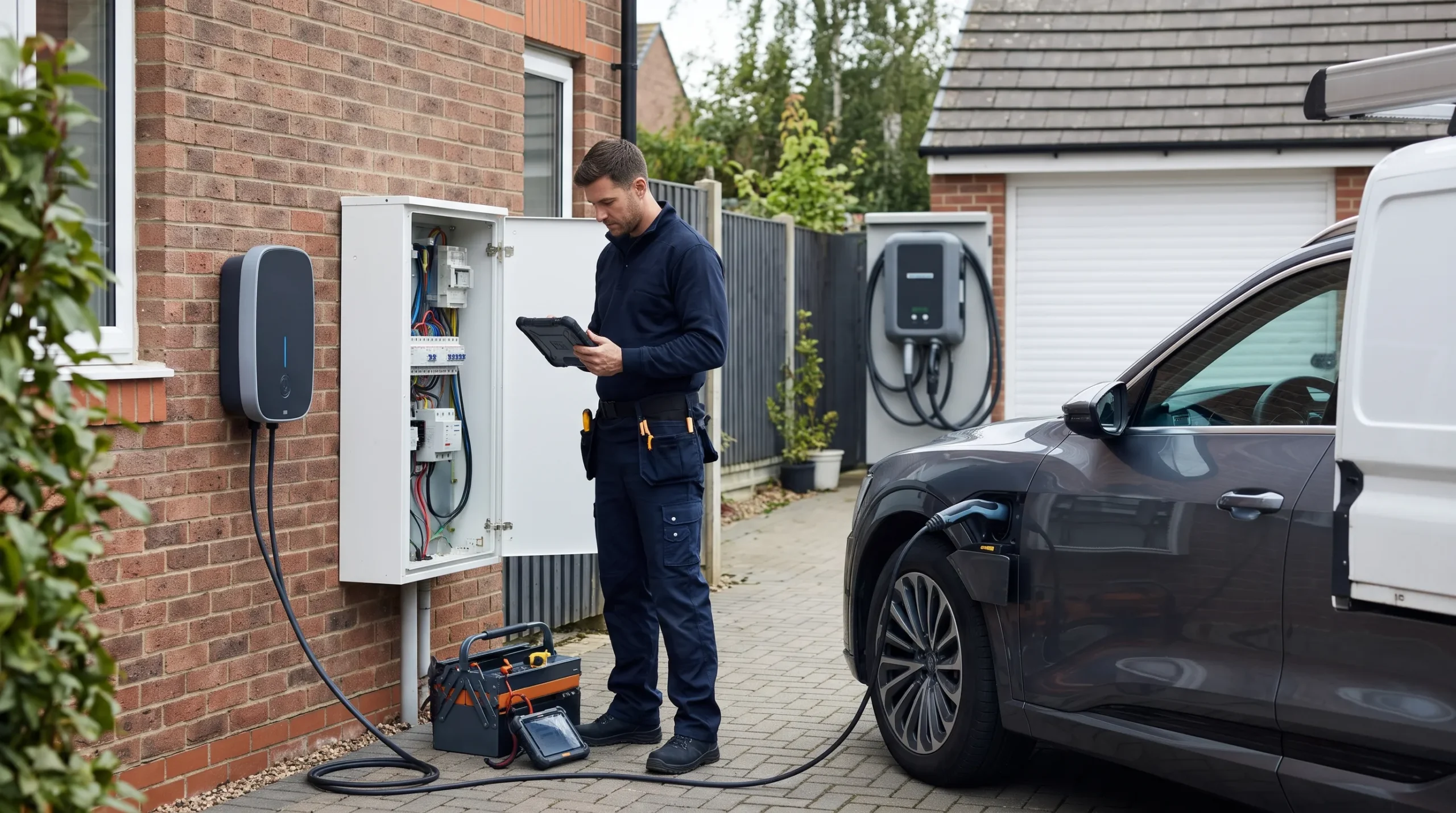
That’s not always easy to tell by eye, and you shouldn’t open any electrical equipment yourself. Your electricity supplier or a qualified installer can confirm it for you. When you order with us, we look at your supply before the install, so you know what the house can run.
If you’re a business, or a larger property with a workshop, a barn or a large heating system, it’s a good question to ask. Three phases are more common there than in ordinary homes.
“Which one should you pick?”
Start with the supply. If your home is single phase, which most are, the choice is already made, and a 7kW charger is the right one.
If your home is three phase, look at the car next. A car that accepts 11kW or 22kW can use a faster charger, and then it comes down to how quickly you need the charge. Most people with three phase and a modern car find 11kW plenty, and only a few need the full 22kW.
If you’re torn, think about your normal day, not your worst day. Work out how many miles you drive, how long the car sits plugged in, and when your cheap electricity runs. For nearly everyone, the cheapest and simplest answer is a good 7kW charger on a night tariff.
Where the VOLEC Pulse fits
The VOLEC Pulse is our 7kW smart home charger, built for a normal single phase home. It uses a Type 2 connector, which fits every current UK electric car, and it’s designed for scheduling around cheap night rates and for load management.
It suits homes with one or two EVs on a single phase supply. A licensed electrician fits it, and we check your supply first so you know what the house can run. You can read the full specification on the VOLEC Pulse page, and the steps are laid out on our installation page.
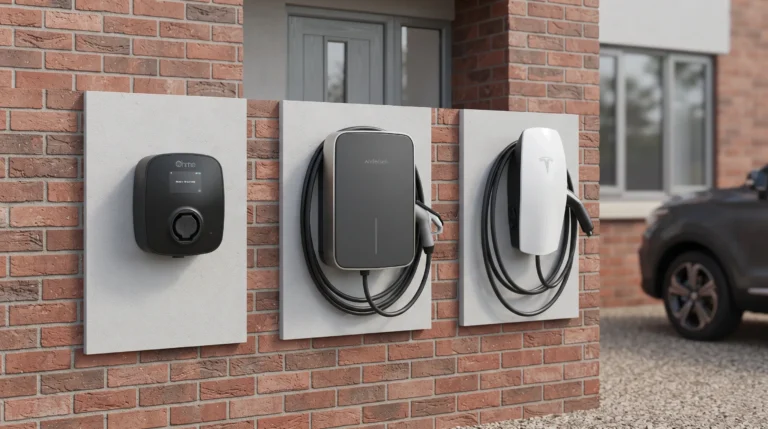
If you’re choosing a cable setup, the comparison of tethered versus untethered chargers and the one on 5m versus 10m cables will help. And if you’re still weighing up the wider market, the best home EV charger buyer’s guide compares what matters, including a look at Ohme, Andersen and Tesla chargers.
Quick Answers
What is the difference between a 7kW and a 22kW home EV charger?
A 7kW charger sends up to about 7.4kW from a single phase supply. A 22kW charger sends up to about 22kW, but it needs a three phase supply, which most UK homes don’t have. The car also has to accept that much power.
Can a UK home have a 22kW charger?
Only if your home has three phase power, or you pay to have it brought in. Most houses have a single phase. An upgrade involves your network operator and often costs several thousand pounds.
Which cars can charge at 22kW?
Only a small group of cars accept 22kW on AC, and they are mostly older or premium models, such as the Renault Zoe, the BMW i3 and the Tesla Model S and Model X, by version. Most cars take 7.4kW or 11kW. Check your own car’s maximum AC rate in the manual.
Does a 22kW charger charge any faster than a 7kW one?
Only if your supply is three phase and your car accepts more than 7.4kW. On a single phase supply, or with a car that stops at 7.4kW, both chargers deliver the same speed. The car and the supply set the limit, not the label on the box.
Is 7kW enough for overnight charging?
Yes, for nearly every car. In a normal overnight window, a 7kW charger puts in more than a typical day’s driving, and usually enough to take a mid sized battery from low to full. The exceptions are very large batteries run right down every day.
How many miles does a 7kW charger add per hour?
Roughly 20 to 27 miles, based on how efficient the car is. A thrifty car lands near the top of that range and a heavy SUV nearer the bottom.
How many miles does a 22kW charger add per hour?
Up to about 75 miles in good conditions, for a car that can accept 22kW. A car limited to 11kW gets about half of that, and one limited to 7.4kW gets the same as it would from a 7kW unit.
Is an 11kW charger a good middle option?
It can be, but only on three phase. On a single phase supply it gives no extra speed over 7kW. If you do have three phase and your car accepts 11kW, it’s often a better fit than 22kW.
Does a 22kW charger cost more to install?
Usually, yes. It needs heavier cable, bigger protective equipment and a three phase connection, and a supply upgrade can add a lot on top. A 7kW install on a normal single phase supply is simpler and quicker.
Does a faster charger cost more to run?
No. Running cost depends on your electricity tariff and when you charge, not on the charger. A cheap night rate saves far more than a faster charger ever could.
Will a bigger charger future proof a home?
Not on a single phase supply. A newer, faster car still charges at the limit your house allows, which is 7.4kW, and that works fine overnight. Future proofing only matters if you plan to move to a three phase property or upgrade your supply anyway.
How can a homeowner tell if the supply is single phase or three phase?
Your installer or electricity supplier can confirm it. A single phase supply has one live cable into the main fuse, and three phase has three. We check your supply before the install, so you’ll know before you commit.
Get a charger that matches your supply
Not sure which one your home can take? Get in touch and we’ll check your supply and arrange a qualified installer. Use our contact page, or have a look at the FAQ for more on how the Pulse and our installer network work together.