If you’ve already got solar panels, or a home battery sitting alongside them, not every EV charger on the market is built to work well with that setup. The short answer for most UK homes in this position is a charger with genuine solar aware charging and automatic load management built in, like the VOLEC Pulse. A standard charger just draws a fixed amount regardless of what your panels are producing.
Here’s what separates a solar friendly charger from a standard one, how that plays out with a home battery in the mix, and what to look for before you buy.
What Does “Solar Aware” Mean on a Charger?
A solar aware charger watches how much your panels are generating in real time and adjusts how much power it sends to the car to match. On a bright afternoon with plenty of surplus generation, it ramps up. On an overcast morning with barely enough solar to run the kettle, it scales right back instead of pulling the difference from the grid at full rate.
The VOLEC Pulse does this without any separate monitoring hardware bolted on. The charger itself handles the solar tracking and adjusts charging automatically, so you’re not buying a charger and then a second box just to make the two systems talk to each other. A standard charger, by comparison, draws the same fixed current whether your panels are flat out or producing nothing at all, which means a lot of that daytime charge ends up paid for at grid rate instead of covered by what your roof is already generating for free.
Does This Work With a Home Battery Too?
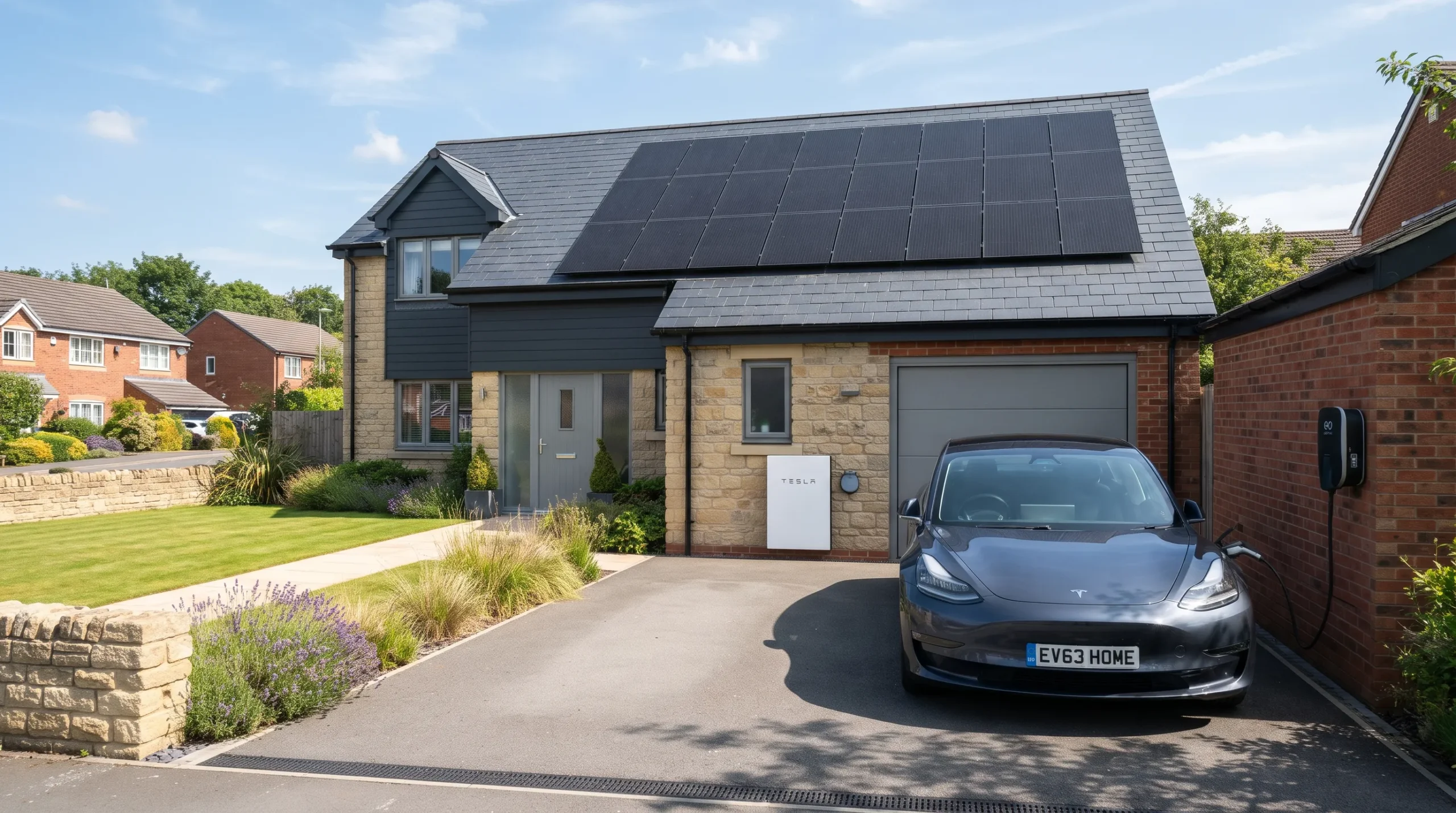
Yes, and this is where the setup gets genuinely useful, not just convenient. A home battery, whether that’s a Tesla Powerwall, a GivEnergy unit, or something similar, stores surplus solar generation for use later instead of letting it export to the grid at a lower rate. Pair that with a solar aware charger and you get two ways to use your own generation: charging the car directly while the sun’s out, or drawing from the battery once it’s dark and the car still needs topping up.
The charger doesn’t need to know anything special about your specific battery brand to make this work. It’s reading your property’s overall power flow, generation versus consumption, and adjusting accordingly, whether that power’s coming straight off the roof or out of a battery that filled up earlier in the day. That’s a meaningfully different setup from a basic charger that just pulls a flat rate from whatever’s on the circuit, battery or not.
Do You Need Extra Hardware for This to Work?
With the VOLEC Pulse, no. The solar aware and load management features are built into the charger itself, so there’s no separate CT clamp kit or third party monitoring box to add on top. That matters more than it sounds, since a lot of solar compatible chargers on the market need an extra hardware purchase and a second install visit to unlock the feature they’re advertised for.
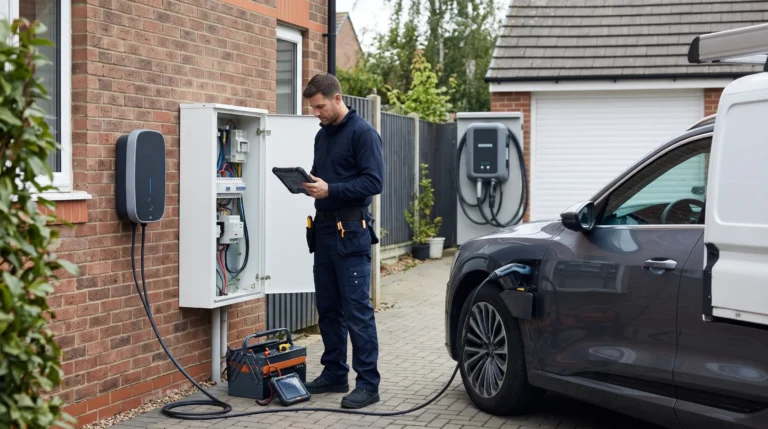
Our installation partners confirm compatibility with your existing solar setup at the same visit they fit the charger, so it’s one appointment, not two. If your property already has a smart meter or an existing solar inverter with its own monitoring, the charger works alongside that instead of needing to replace it.
What Does Automatic Load Management Protect You From?
This is the feature that matters most once solar, a home battery, and an EV charger are all drawing from or feeding into the same property at once. If your supply’s spare capacity changes, say your battery’s discharging heavily into the house at the same time the charger’s running, automatic load management steps the charger’s output down instead of letting the whole setup trip the main fuse.
Without this, adding an EV charger to a property that’s already running solar and battery storage can genuinely overload what the incoming supply was designed for. With it, the charger just adjusts itself in the background. You don’t need to think about whether it’s safe to charge the car while the washing machine, the battery, and the solar inverter are all doing their own thing at the same time. Our guide on EV charger load management goes into when this becomes essential and when a property’s supply has enough headroom that it matters less.
Does the App Give You Control Over Any of This?
Yes. The VOLEC Pulse connects over Wi-Fi, and the app lets you schedule charging, check on solar tracking, and adjust the amperage ceiling after your electrician sets the initial safe limit during installation. For a solar and battery setup specifically, that means you can choose to prioritise solar only charging during daylight hours, or let the system blend solar, battery, and grid power automatically depending on what’s available at any given moment.
Some owners prefer a hands off approach and just let the solar aware feature run on its own. Others like fine tuning the schedule around their own routine, charging only on sunny days and switching to an overnight tariff the rest of the time. Our comparison of smart versus standard EV chargers covers what the app adds beyond the solar tracking itself.
How Much Does a Solar Compatible Charger Like This Cost?
The VOLEC Pulse is priced at £899, which covers the charger itself with solar aware charging and automatic load management built in as standard, not sold as a separate add on tier. Installation is quoted separately once one of our vetted partners has looked at your property, since the cost depends on your consumer unit, cable run, and how your existing solar and battery system is wired in. Our breakdown of EV charger installation cost covers what typically pushes that figure up or down.
A lot of other chargers on the market handle this by selling a standard unit, then a separate solar integration kit afterward. The built in approach usually works out simpler and often cheaper overall, since you’re not paying for a second product and a second install visit.
What’s the Difference Between Tethered and Untethered Here?
The Pulse connects through a Type 2 socket instead of a fixed tethered cable, with your own cable plugging in each time you charge. The standard cable runs 18 feet, with 24 foot and 30 foot options available for properties where the car parks further from the charger. This matters slightly more on a solar and battery setup than on a standard install, since flexibility in where the car parks relative to the charger can affect how consistently it catches daylight charging hours if your driveway has partial shade at certain times of day. Our comparison of tethered versus untethered EV chargers covers which setup suits which kind of driveway.
What Should You Watch for on Other “Solar Compatible” Chargers?
Not every charger advertised as solar compatible works the way the Pulse does. A lot of models on the market need a separate CT clamp kit fitted to your consumer unit before solar tracking switches on at all, which means budgeting for that extra part and a longer install visit on top of the charger’s own price. Others only support solar tracking through a third party app that has to be paired separately from the charger’s own controls, so you end up managing two apps instead of one.
Worth checking, too, whether a charger’s solar feature adjusts output in real time or just switches between a handful of fixed modes. Some budget models offer a basic “solar only” toggle that simply stops grid charging entirely instead of blending the two. That sounds similar on a spec sheet, but behaves very differently day to day, especially on a partly cloudy afternoon where generation keeps shifting.
How Much Could Solar Charging Save Over Time?
Charging a typical EV battery fully from the grid at a standard tariff usually costs somewhere between £8 and £15. Charge that same amount from solar generation you’re already producing, and the marginal cost drops close to zero beyond what the panels cost to install in the first place. For a household charging two or three times a week, that difference adds up to a meaningful yearly saving, on top of whatever the panels are already saving on general household electricity use.
A home battery adds a second layer to that saving. Surplus daytime generation that would otherwise sit unused, or export to the grid at a lower rate than you pay to import, gets stored for an evening charge instead. Exactly how much this saves depends on your panel size, your household’s usage pattern, and your current tariff, but most owners running solar, a battery, and a solar aware charger together see a noticeably lower EV charging cost than someone charging the same car on a standard grid only setup.
Do You Need Solar Already Installed, or Does This Work for Future Plans Too?
Either way, really. If solar’s already on your roof, the Pulse starts tracking and adjusting from day one. If you’re planning to add solar later but want a charger now that won’t need replacing when you do, choosing a solar aware model from the start means you’re not paying twice, once for a basic charger now and again for a solar compatible one later.
The same logic applies to a home battery you haven’t bought yet. The charger reads your property’s overall power flow instead of needing to be paired specifically to a battery brand, so adding a battery down the line doesn’t require swapping the charger out either.
Quick Answers
Does a solar aware charger cost more than a standard one?
Not necessarily. The VOLEC Pulse includes solar aware charging and load management as standard at £899, instead of charging extra for the feature on top of a base price.
Will this work with any home battery brand?
Yes. The charger reads your property’s overall solar generation and power flow instead of needing a specific integration with any one battery manufacturer, so it works alongside Tesla Powerwall, GivEnergy, and similar systems.
Can the charger slow down the car’s charging too much on a cloudy day?
It can, if you’ve set it to solar-only mode and generation’s genuinely low. Most owners blend solar with a grid or an overnight tariff through the app instead of relying on solar alone every single day.
Does solar aware charging need its own separate installation appointment?
No, with the Pulse it’s set up and confirmed during the same visit as the rest of the installation, since there’s no separate monitoring hardware to fit.
Is a 7kW charger powerful enough for a solar and battery setup, or is something bigger needed?
7kW comfortably suits almost all UK home installs, solar and battery included. Our guide on 7kW home EV chargers covers why this became the standard output for home charging.
Does the load management feature slow down other appliances in the house?
No, it only adjusts the charger’s own output based on the property’s spare capacity. Other appliances run as normal, and the charger is the one adapting in the background.
Can the charging schedule be changed once it’s set up?
Yes, at any point through the app. Amperage, scheduling, and solar priority can all be adjusted after installation without needing another visit.
Is this charger a good fit for a property without off street parking?
Solar aware charging and load management both work the same regardless of where the car parks. The bigger factor for any charger without off street parking is where the unit itself can be safely mounted and whether a cable run is practical.
Get the VOLEC Pulse Quote
Already running solar, a home battery, or planning to add either? Check the full Volec Pulse product page for specs and pricing, or get in touch through our contact page and we’ll connect you with a vetted installation partner who can confirm compatibility with your setup before booking. Our FAQ page covers more on how the Pulse and our installer network work together.