In the UK, almost every new home EV charger is already “smart” by law. Since 30 December 2022, chargers sold in Great Britain have had to meet the Smart Charge Point Regulations: they must connect to a network, let you schedule charging, avoid weekday peak hours by default, add a short random delay when a session starts, and meet security rules. So the choice you face today is between a charger that only meets that legal minimum and one that adds load management, solar charging, tariff support and a good app. A standard, non smart charger now mostly means an older unit, installed before the rules came in. For most buyers, a fully featured smart charger is worth having, and it’s worth comparing the actual prices of both.
Here is the short version. Buy the basic compliant model if you have a simple supply, no solar, a flat rate tariff and you only want the car to charge. Buy a fully featured one if you want to use a cheap night tariff properly, you have solar panels, your fuse box is old or small, or you want the charger to keep itself up to date.
Fully featured, and legally smart: VOLEC Pulse 7kW, Type 2, tethered 5m or 10m cable, app scheduling, load management, solar aware, over the air updates, IP66, 10 year warranty. £279 with installation arranged at checkout. See the VOLEC Pulse
The table separates what the law requires from what’s optional. The sections after it explain each row.
| Feature | Basic compliant charger | Fully featured smart charger |
| Legal smart minimum | Yes | Yes |
| Default off peak hours and random delay | Yes | Yes |
| Scheduling | Yes, often with a simple interface | Yes, through an app with more control |
| Energy use history | Yes, a legal requirement | Yes, usually easier to read |
| Load management | Often not included | Included on better models |
| Solar aware charging | Often not included | Included on better models |
| Tariff support | Varies | Check each supplier’s compatible list |
| Over the air updates | Varies | Included on better models |
| Price | Lowest | A little higher |
“What does the law actually say a smart charger must do?”
The rules come from the Electric Vehicles (Smart Charge Points) Regulations 2021, and they apply to chargers sold in Great Britain. Northern Ireland is not covered.
A compliant home charger has to send and receive information over a network, respond by changing the rate or timing of charging, and have at least one user interface, which can be a physical control or an app. It has to keep its smart features if you change electricity supplier. It must let you see your energy use for the previous 12 months, measured to within 10 percent.
Then there are the charging defaults. Weekday peak hours are 8am to 11am and 4pm to 10pm, and the charger should not charge by default in those windows. You can change or remove those hours yourself, and override them whenever you like. The charger also adds a random delay of up to ten minutes at the start and end of a session, so thousands of cars don’t all switch on at once. Finally, chargers sold from 30 December 2022 have to meet security rules, including encrypted communication, unique passwords and a log of tamper attempts.
Every compliant charger does all of that. So none of it separates one model from another. The useful differences sit on top.
“Are standard, non smart chargers still sold?”
For new sales in Great Britain, they shouldn’t be. A charger sold after the rules took effect has to be compliant.
You may still meet a “standard” charger in a home that had one fitted before the rules. It charges whenever you plug in, with no schedule and no app. If you’re buying new, ask for the statement of compliance. Sellers have to provide one with each sale.
If your current charger is an older one, it keeps working. You aren’t forced to replace it. But it won’t help you use a night tariff, and it can’t protect your fuse box the way a load managed unit can.
“Why does scheduling matter so much?”
Because it’s where the money is.
A charger with scheduling waits until your cheap window, then starts. On a standard tariff at the Ofgem price cap, electricity costs about 26p per kWh from 1 October 2026. On a night EV tariff such as Intelligent Octopus Go, the off peak rate is around 7.6p between 11:30pm and 5:30am. Take a 30 mile daily drive. That’s roughly 8.6kWh in the battery, or about 9.5kWh from the grid once charging losses are counted. At 26p that’s about £2.50 a day. At 7.6p it’s about 72p. The gap comes to roughly £650 over a year.
A charger that starts the moment you plug in at 6pm puts all that charging in the expensive window. A scheduled one moves it to the cheap hours without you remembering anything. This is the main reason to want a smart charger, and every compliant one can do the basic version. What differs is how easy it is to set up, and whether it works with your tariff.
“Will my charger work with my energy tariff?”
Check the tariff before you buy, because the answer differs by type.
A simple time of use tariff, where the cheap window is fixed, works with almost any charger that can schedule. You set the charger to run inside the window, and that’s all.
Smart tariffs like Intelligent Octopus Go go further. They control charging through a compatible charger or through the car’s own app, and the supplier keeps a list of approved units. If you want one of those tariffs, check that list for the model you’re considering. Ask the seller as well. If a tariff matters to you, it’s far easier to confirm before ordering than after the installer has left.
“What is load management, and do I need it?”
Load management is the feature most buyers have never heard of, and it’s one of the most useful.
A 7kW charger draws about 32 amps. That’s a big load on top of a shower, an oven and an immersion heater. With load management, the charger reads your home’s total current and lowers its own output when something else switches on. It raises it again when that stops. You stay inside your supply limit and you still charge as fast as the spare capacity allows. Without it, an installer often has to fix the charger at a lower speed to stay safe.
It isn’t required by the smart charging rules. Some basic units leave it out, and some include a simple version. If your fuse box is old, your supply is small, or you run heavy appliances in the evening, it’s worth wanting.
Not sure if your home supply can handle a 7kW charger? VOLEC includes a free panel check before installation. Start your free panel check
“What does solar aware charging add?”
If you have solar panels, quite a lot.
A solar aware charger detects surplus power from your panels, meaning power your house isn’t using, and shifts charging to soak it up. Without it, that surplus goes to the grid for a small export payment, and you charge the car from the grid later at a higher price. With it, the car uses your own generation first.
The smart charging rules don’t require it either, so check the detail. Some chargers need a sensor clamp on the supply cable. Some only work with certain inverters. Ask whether it can run on surplus alone, and whether it can top up from the grid on a cloudy day when you need the car ready.
“Does the app matter?”
More than you’d think, because it’s what you use every week.
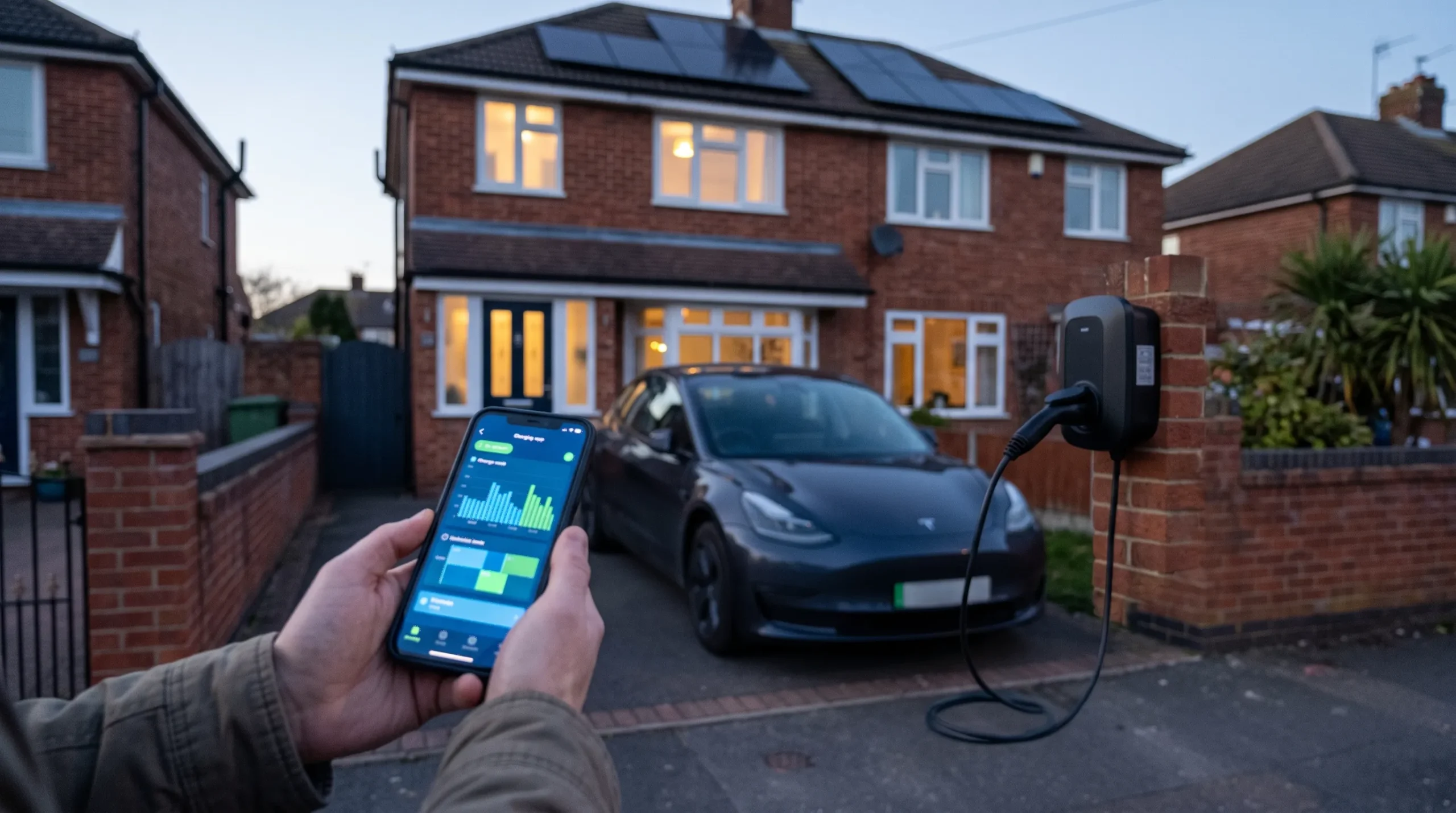
A good app lets you start and stop sessions, set a schedule, change the charging current and see how much each session used. Under the rules every charger has to show 12 months of energy use somewhere, but a clear screen in your pocket is much easier than a tiny display on the wall.
Check what happens when things go wrong. A compliant charger must keep charging your car if it loses its network connection, so a Wi-Fi drop at 2am shouldn’t leave you with a flat battery. Ask what you can still control from the charger itself without the app. Also check the Wi-Fi signal where the charger will hang, because plenty of driveways sit at the far edge of the router’s range.
“How long will the charger get software updates?”
Ask this one before you pay. It’s a question most buyers skip.
Chargers are small computers, and tariffs, standards and security threats all change. Under the rules, sellers must tell you how long security updates will be provided, so you can ask for that date. A charger that updates itself over the air stays current without anyone visiting. One that needs an installer to update it often stays on its original software for good.
A long warranty tells you something too. The Pulse carries ten years covering parts, labour and the electrical connection. Read the exclusions on any warranty you’re offered, because software and app support can sit outside it.
“Is a smart charger worth paying more for?”
For most homes, yes. Scheduling alone can save hundreds of pounds a year, so compare the real price gap between the two models you’re considering against that.
The only case for a basic model is a very simple setup: a stable supply with plenty of spare capacity, no solar, no smart tariff and no interest in an app. If you may add solar, a battery or a heat pump in a few years, a feature rich charger could save you a second purchase.
The wrong way to decide is on the word “smart” alone, since every new charger carries it. Compare the specific features in the table above, and ask what each model includes.
Smart or standard: how it fits with the other choices
Smart features don’t depend on the cable. Scheduling, load management and solar charging work the same whether you pick a fixed cable or a socket. If you’re still deciding between those, our guide to tethered vs untethered EV chargers goes through it.
Smart features don’t raise charging speed either. The speed comes from the charger’s power and your car’s onboard charger, which we cover in the post on whether a 7kW home EV charger is enough. And for every feature worth comparing, the buyer’s guide to the best home EV charger in the UK puts them side by side.
Where the VOLEC Pulse fits
The VOLEC Pulse is a 7kW smart home charger at £279, with installation arranged at checkout. On top of the legal smart minimum it has adaptive load management, solar aware charging, app scheduling over Wi-Fi and over the air updates. The casing is IP66, and the warranty is ten years covering parts, labour and the electrical connection.
It suits a home with one or two EVs, a driveway or garage wall, and a wish to use night tariffs properly. If your supply is tight, start with the free panel check, which tells you what the house can run before you pay for anything. Questions about your own setup can go through the contact page, and the installation steps are on the installation page.
Three mistakes to avoid
Choosing on the word “smart” alone, when every new charger has it.
Skipping the tariff check, then finding the charger isn’t on your supplier’s compatible list.
Ignoring load management on an older home, then paying for a lower fixed speed.
Frequently asked questions
What is the difference between a smart EV charger and a standard one?
In Great Britain every new home charger must meet the Smart Charge Point Regulations, so all of them are smart at a basic level. The difference is in the extras: load management, solar charging, tariff support, a good app and over the air updates.
Do I need a smart EV charger in the UK?
Yes, if you’re buying new. Home chargers sold in Great Britain have to meet the Smart Charge Point Regulations, in full since 30 December 2022. An older charger fitted before the rules keeps working.
Will a smart charger charge at off peak times by default?
Yes. By default it should avoid the weekday peak hours of 8am to 11am and 4pm to 10pm, and add a random start delay of up to ten minutes. You can change or remove these settings yourself.
Does a smart EV charger still work without Wi-Fi?
A compliant charger must keep charging your car if it loses its network connection. You may lose app control until the connection returns, so ask what you can still do from the unit itself.
Can I use a cheap night tariff with any smart charger?
A fixed time of use tariff works with any charger that can schedule. Smart tariffs such as Intelligent Octopus Go need a compatible charger or car, so check the supplier’s list before you buy.
Is a smart EV charger worth the extra cost?
For most homes, yes. Scheduling on a night tariff can save roughly £650 a year on a 30 mile daily drive at current rates, so compare that against the price gap between the two models you’re considering.